The Lake That Hungarians Treat Like the Sea — And Why
By Kata | katabudapest.com | Updated June 2026
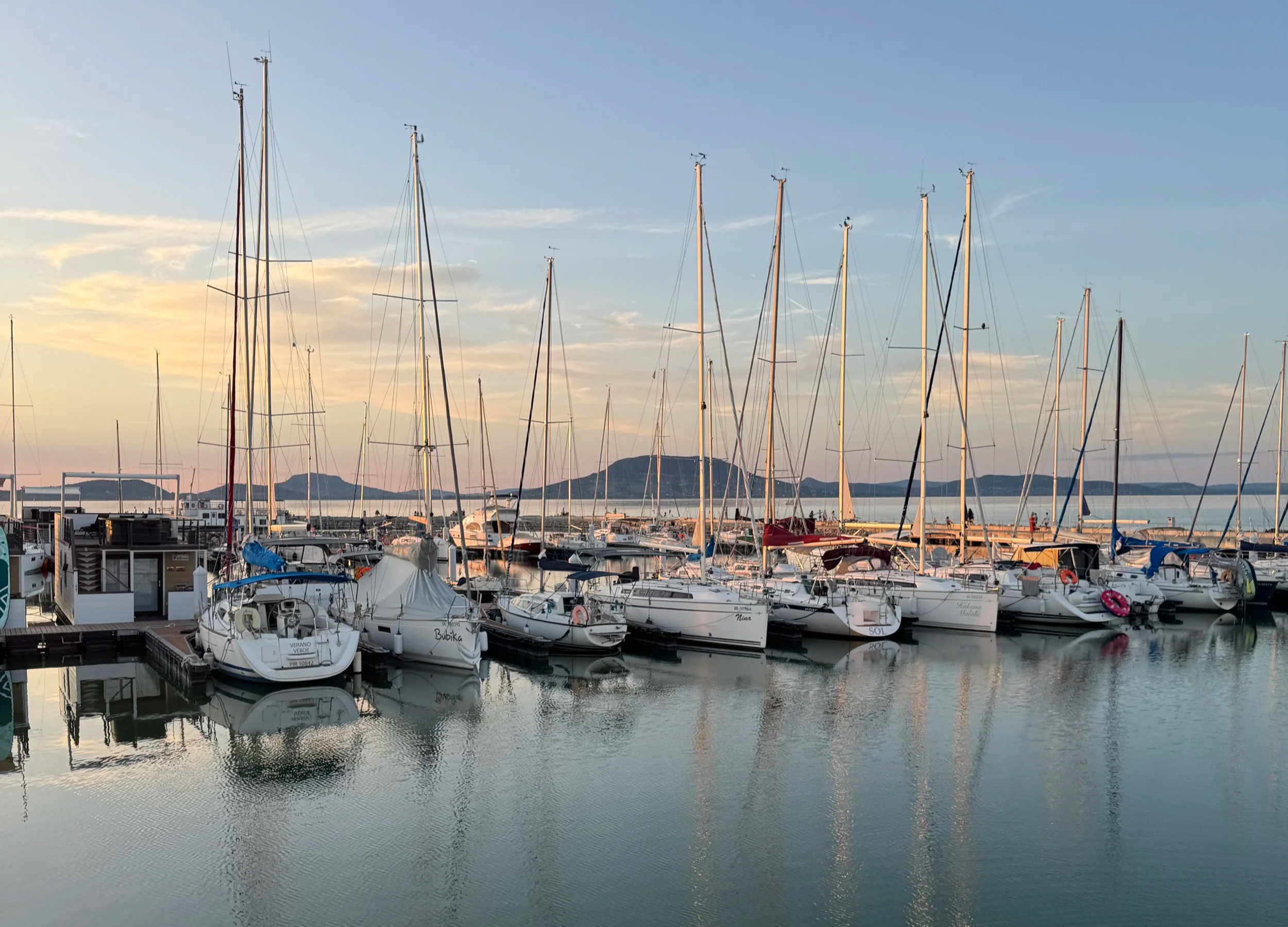
Sailing boats on Lake Balaton at golden hour
Every country has a place that holds its soul. For France it is the villages of Provence, the lavender fields and the stone walls and the particular light of a southern afternoon. For Greece it is the Aegean, which is not a sea but a state of mind. For England it is the coast — the chalk cliffs, the grey water, the feeling that the island knows exactly where it ends.For Hungary it is a lake. A freshwater lake in the middle of Central Europe, surrounded by gentle hills and vineyards and a hundred years of shared memory — shallow enough that children can wade out for minutes before the water reaches their waist, warm enough in July to stay in until the sun goes down, wide enough that on misty mornings you cannot see the other shore. Seventy-seven kilometres long. Fourteen kilometres wide at its broadest point. The largest lake in Central Europe and the smallest sea in the world — at least in the hearts of the ten million people who call it their own.
This is Lake Balaton.
The Geography First — Because It Explains Everything
Hungary is landlocked. Completely, absolutely, entirely landlocked — surrounded on all sides by Austria, Slovakia, Ukraine, Romania, Serbia, Croatia, and Slovenia, with no coastline, no access to any ocean, no maritime tradition of any kind. This is not unusual in Europe. But Hungary is also flat — the Great Plain, the Alföld, covers more than half the country in a vast agricultural flatness that is beautiful in its own way but offers nothing in the way of dramatic natural scenery. No mountains to speak of. No dramatic coastline. No fjords, no cliffs, no sea. What Hungary has is Balaton. And Balaton — warm, shallow, enormous by Central European standards, surrounded by gentle hills on the north shore and flat agricultural land on the south — became, by necessity and by love, the Hungarian sea. That is what Hungarians actually call it. Not ironically. Not with quotation marks around the word. With complete sincerity and a straight face. The name is not metaphor. It is identity.
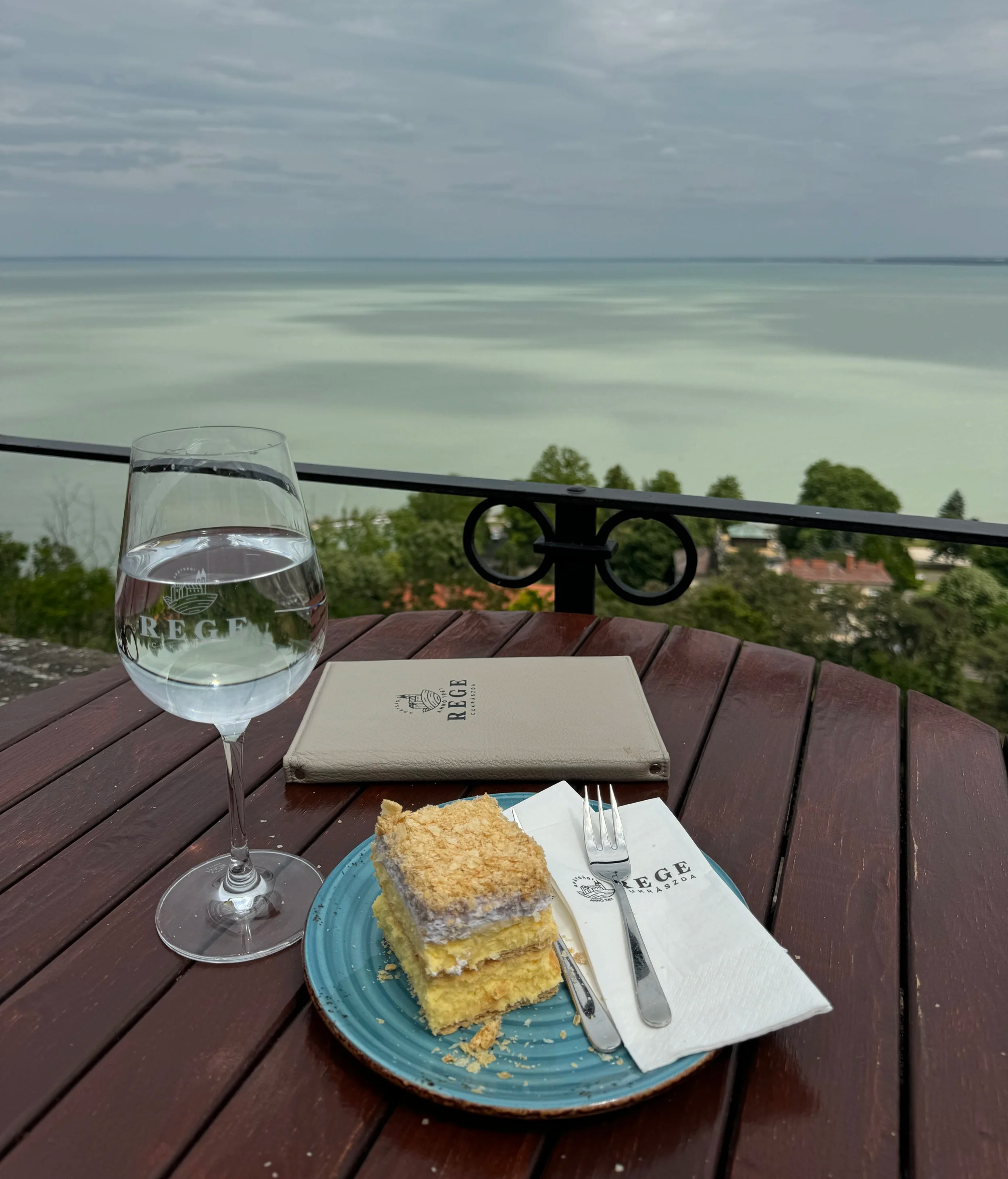
Tihany — lavender krémes and Lake Balaton panorama
What Lake Balaton Actually Is
Lake Balaton sits about 120 kilometres southwest of Budapest, reachable by train in under two hours or by car in roughly the same time depending on summer traffic — and in July and August, summer traffic on the M7 motorway toward Balaton is a Hungarian institution unto itself, as reliable and as anticipated as the lake itself.The lake is shallow — famously, almost ridiculously shallow, averaging around three metres deep with a maximum depth of about twelve metres. This shallowness is both its greatest charm and its most distinctive characteristic. The water warms up quickly in early summer and stays warm through September. Children can wade out an extraordinary distance from the shore before the water reaches their waist. The bottom is soft reed and clay rather than rocks or sand, which produces a particular sensation underfoot that every Hungarian knows from childhood and that visitors either love immediately or take a moment to adjust to.
The north shore is hilly and volcanic — the Badacsony wine region rises directly from the water's edge, its basalt peaks covered in vineyards that produce some of Hungary's finest white wines. Villages here are old, stone-built, and quiet in the way that places which have been beautiful for a very long time tend to be quiet — they do not need to announce themselves.
The south shore is flat and developed — long stretches of beach, summer resorts, the particular infrastructure of a place that has been hosting Hungarian holidays for over a century. Siófok is the largest town on the lake, the closest thing Balaton has to a capital, and in July it is approximately as quiet as a city that never sleeps.
Between the two shores the lake stretches wide enough that on misty mornings you genuinely cannot see the other side. This is the moment when the sea comparison stops being metaphorical and starts feeling, for just a second, entirely accurate.
The History of a Hungarian Obsession
Hungarians did not always treat Balaton as their sea. The relationship developed gradually and then all at once, the way most great loves do. For most of its history Balaton was primarily a fishing lake — important economically, unremarkable emotionally. The villages on its shores lived from fishing and agriculture. The water was there, the way water is always there, without particular significance beyond the practical. The turning point came in the second half of the nineteenth century, when the railway arrived.
The Hungarian railway network expanded rapidly in the 1860s and 1870s, and when the line reached the south shore of Balaton in 1861 and the north shore in 1909, everything changed. Suddenly Budapest — which had become a booming, industrialising capital city with a rapidly growing middle class — was connected to the lake. A weekend journey became possible. Then a week. Then the entire summer. The Hungarian bourgeoisie discovered Balaton and fell completely in love with it. Villas were built along the shore. Steamships crossed the lake. Hotels opened. The infrastructure of leisure — piers, bath houses, promenades — appeared along the waterfront with the particular speed of a country that has decided something matters. By the early twentieth century, Balaton was established as the Hungarian summer destination. Not one of several. The one. Then came the communist period — and Balaton became something even more significant.
Balaton Under Communism — When the Lake Became Everything
During the decades of communist rule in Hungary — from 1949 to 1989 — foreign travel was restricted, controlled, and for most Hungarians practically impossible. The world beyond the Iron Curtain was inaccessible. The Adriatic, the Mediterranean, the beaches of Western Europe — these existed in magazines and imagination but not in reality. Balaton was what Hungarians had instead. The communist state invested heavily in Balaton infrastructure — not out of sentiment but out of practical necessity. Workers needed holidays. Holidays needed somewhere to go. Enormous state-owned holiday complexes — üdülő — were built along the shore, organised by trade union and profession. Factory workers from Miskolc stayed in the metalworkers' complex. Teachers from Budapest stayed in the teachers' union complex. Miners, railway workers, hospital staff — each had their designated section of shore, their allocated weeks, their specific building with its institutional food and its organised entertainment and its access to the same water that everyone else was swimming in.
It was, by Western standards, a modest and regimented way to spend a holiday. By the standards of a country where the alternative was no holiday at all, it was extraordinary. And something happened in those crowded, institutional, sometimes uncomfortable decades that nobody entirely planned. Balaton became not just a holiday destination but an emotional anchor. The one constant in a country where almost everything else was controlled, uncertain, or subject to change. The lake was always there. The water was always warm in July. The children always learned to swim in the same shallow south shore water their parents had learned to swim in. The vineyards on Badacsony always produced the same wine. The sunset over the water was always the same sunset. In a system designed to manage and control every aspect of life, Balaton was the one thing that simply was — unchanged, unchosen, ungovernable. Hungarians loved it with the particular intensity of people who have learned to treasure what cannot be taken away. That love did not end in 1989. It deepened.
What Balaton Means to Hungarians Today
Ask a Hungarian about Balaton and watch what happens to their face. It is not the polite enthusiasm of someone describing a nice place they have visited. It is something closer to what happens when you ask someone about their childhood home — a particular softening, a particular warmth, the specific expression of a memory that is not just pleasant but formative. For most Hungarians of a certain generation, Balaton is where summer happened. Where they learned to swim. Where they ate lángos for the first time and understood that fried dough topped with sour cream and cheese was one of the great achievements of human civilisation. Where they stayed up too late and caught frogs in the reeds and fell in love for the first time and had the kind of days that do not feel like days because time at Balaton moves differently from time anywhere else.
The sociologist could explain this in terms of collective memory, of shared cultural experience, of the particular bond that forms when an entire nation spends its summers in the same place for a hundred years. All of that is true and none of it quite captures it. What Balaton is, for Hungarians, is the place where life slows down enough to be properly felt. Where the urgency of Budapest — of work, of traffic, of the particular intensity of a capital city — releases its grip and something simpler and better takes its place. It is not nostalgia exactly. It is something more present than nostalgia. It is the feeling that this — the warm water, the wine, the sunset, the particular smell of the lake in the evening — is what things are actually for.
The Balaton Experience — What You Actually Find There
The Water
Swimming in Balaton is unlike swimming anywhere else. The water is warm — genuinely warm, not the aspirationally warm of a British summer sea — from June through September. The shallowness means you can wade out fifty, sixty, a hundred metres from the shore in some places before the water reaches your chest. Children play in it all day. Adults float in it for hours. The reeds at the water's edge are alive with frogs and dragonflies and the particular small sounds of a working ecosystem. The south shore has the long sandy beaches and the family infrastructure — the changing rooms, the espresso bars, the lángos stands, the beach volleyball nets. The north shore has smaller, quieter shores, better wine, and the particular beauty of the Badacsony hills rising behind you while you swim. Both are Balaton. Both are worth knowing.
The Food
Balaton has its own food culture, which is an extension of Hungarian food culture but with specific local additions that are essential to experience.
Fogas — pike-perch — is the fish of Balaton, indigenous to the lake and eaten in every form: fried, grilled, in soup, smoked. A plate of fogas with a glass of cold Badacsony Olaszrizling on a terrace overlooking the lake is one of the finest simple meals in Hungary.
Lángos — deep fried dough with sour cream and cheese — is everywhere, but Balaton lángos has a particular reputation. Eaten at the beach, still hot from the oil, with bare feet and wet hair, it tastes better than it does anywhere else. This is not imagination. It is context, which is a legitimate ingredient.
Badacsony wines — white wines from the volcanic soils of the north shore, particularly Olaszrizling and Szürkebarát — are some of the finest white wines in Hungary and among the most underappreciated in Europe. Drink them cold, on a terrace, as close to the water as possible.
The Sunsets
Balaton sunsets are famous among Hungarians and discovered with surprise by visitors who were not expecting to be stopped in their tracks by a lake in Central Europe.
The combination of the wide, flat water, the volcanic hills of the north shore, and the particular quality of Central European summer light produces sunsets of extraordinary colour — long, slow, painting the lake in shades of orange and pink that linger for an hour after the sun has gone. People stop what they are doing to watch them. Conversations pause mid-sentence. Children stop running.
This is, I think, one of the things Balaton does that the sea sometimes does not — it gives you the whole sky reflected back at you, doubled in the still water, the sunset above and the sunset below simultaneously, until you are standing in the middle of a painting that nobody made.
The Towns
Balatonfüred on the north shore is the oldest and most elegant Balaton resort — a spa town since the eighteenth century, with a beautiful promenade, the Anna Ball tradition that goes back to 1825, and the particular unhurried atmosphere of a place that has been welcoming people who need to slow down for three hundred years.
Tihany, on the peninsula that reaches so far into the lake it nearly divides it in two, has a Benedictine abbey founded in 1055 — the oldest still-functioning monastery in Hungary — sitting above the water on a hill that on clear days feels like the edge of the world. The village below the abbey has lavender fields, artisan shops, and the particular smell of a Balaton summer that you will recognise instantly the second time you encounter it, years later, somewhere completely different.
Keszthely at the western end of the lake has the Festetics Palace — an eighteenth century baroque masterpiece that most visitors drive past on the way to the beach without stopping — and the Helikon Library inside it that is one of the most beautiful rooms in Hungary.
Siófok on the south shore is loud, crowded, enthusiastic, and entirely itself. It is where Hungarian summer goes to stay up until four in the morning and eat lángos at dawn and swim before breakfast. If this sounds like exactly what you need, Siófok will deliver it without apology.
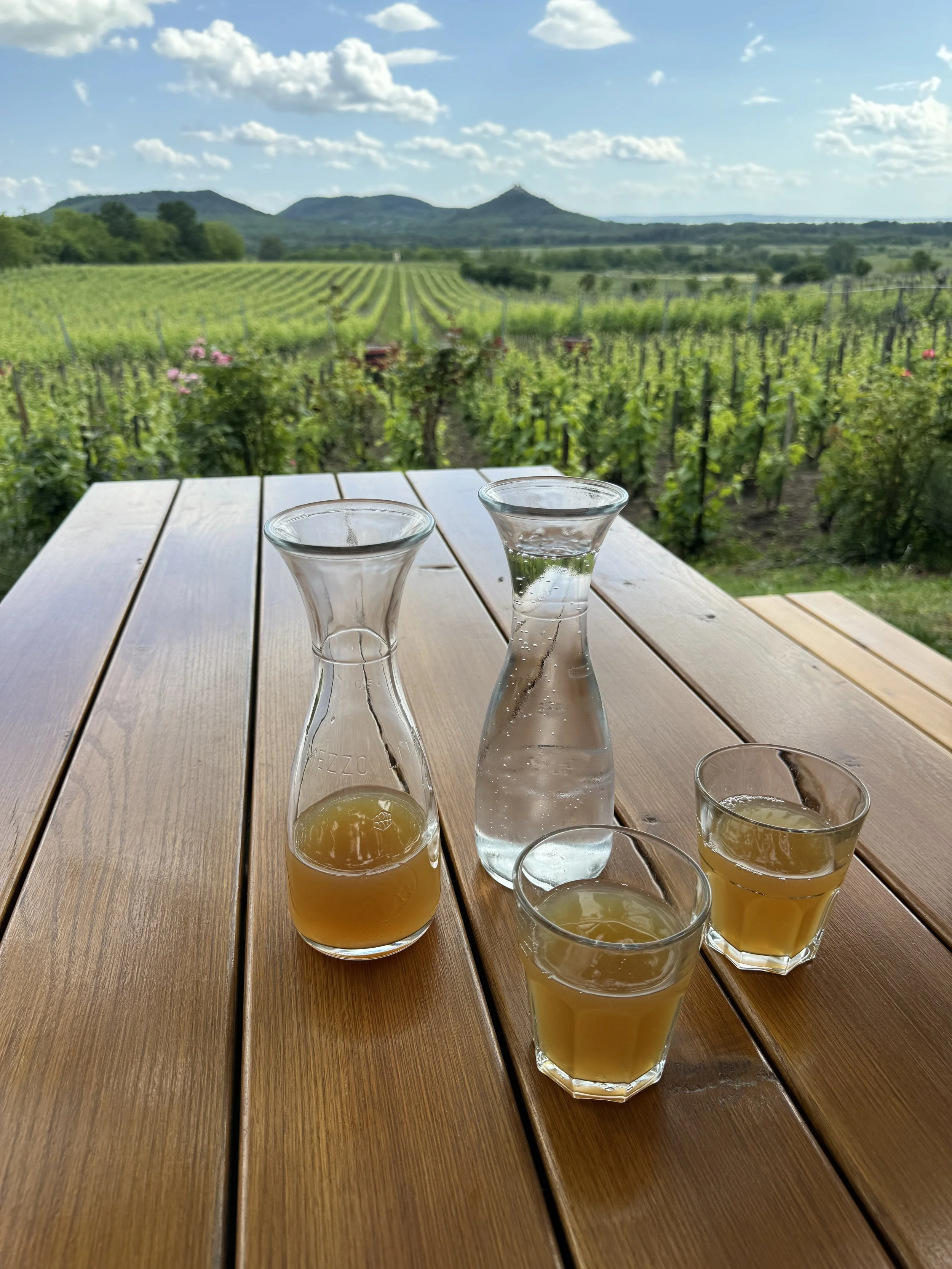
The Hungarian Tuscany — wine and fresh grape jucie among the volcanic hills
Balaton as a Day Trip from Budapest
Lake Balaton is 120 kilometres from Budapest — close enough for a long day trip and far enough to feel like you have actually left. A full day at Balaton — arriving at ten, swimming, eating fogas, watching the sunset, returning to Budapest in the evening — is one of the best days it is possible to have in Hungary. Not the most exhausting, not the most information-dense, not the most culturally improving. Just the best. I offer private day trips to Balaton built around exactly this logic — exploring the south shores, the Badacsony vineyards, Tihany abbey, a long lunch, and the sunset before the drive home. It is, consistently, one of the days guests remember longest.
Why You Should Go
You should go to Balaton because it is beautiful. You should go because the water is warm and the wine is extraordinary and the fogas is fresher than anything you will eat in Budapest. But you should also go because of what it will show you about Hungary that no museum or palace or guided walk through a historic district can show you. You will see Hungarians at rest — properly at rest, the way people are only in the places they have loved since childhood. You will understand something about what this country values, what it returns to, what it cannot do without.
You will stand on the shore in the evening when the lake goes still and the sky turns orange and the hills of Badacsony go dark against the light, and you will understand why a landlocked nation of ten million people built their entire summer culture around a freshwater lake. Because it is theirs. Because it has always been theirs. Because in a history full of things taken away and borders redrawn and certainties dissolved, the lake was always there — warm in July, full of fish, reflecting the same sky it has always reflected. That is what Balaton is. That is why Hungarians treat it like the sea.
I offer private day trips to Lake Balaton from Budapest — the volcanic vineyards of Badacsony, the Benedictine abbey at Tihany, the elegant promenade of Balatonfüred and the sunset over the water before the drive home. Fully private, fully personalised, built entirely around you. Get in touch and let's plan your perfect Hungarian day together.
Planning a trip to Hungary? Read these next:
Hungarian Wine: The Complete Guide to One of Europe’s Best Kept Secrets (2026)
Why You Should Visit the Citadella for Sunset in Budapest
Budapest Christmas Markets 2026: A Local Guide's Honest Guide
The Best Souvenirs to Buy in Hungary — A Local Guide's Honest Picks (2026)
