Budapest Public Transport — A Complete Guide for Visitors
By Kata | katabudapest.com | Published May 2026
Budapest has one of the best public transport systems in Europe. It is extensive, reliable, affordable, and — once you understand how it works — genuinely enjoyable to use. The tram along the Danube embankment alone is worth the price of a travel pass.
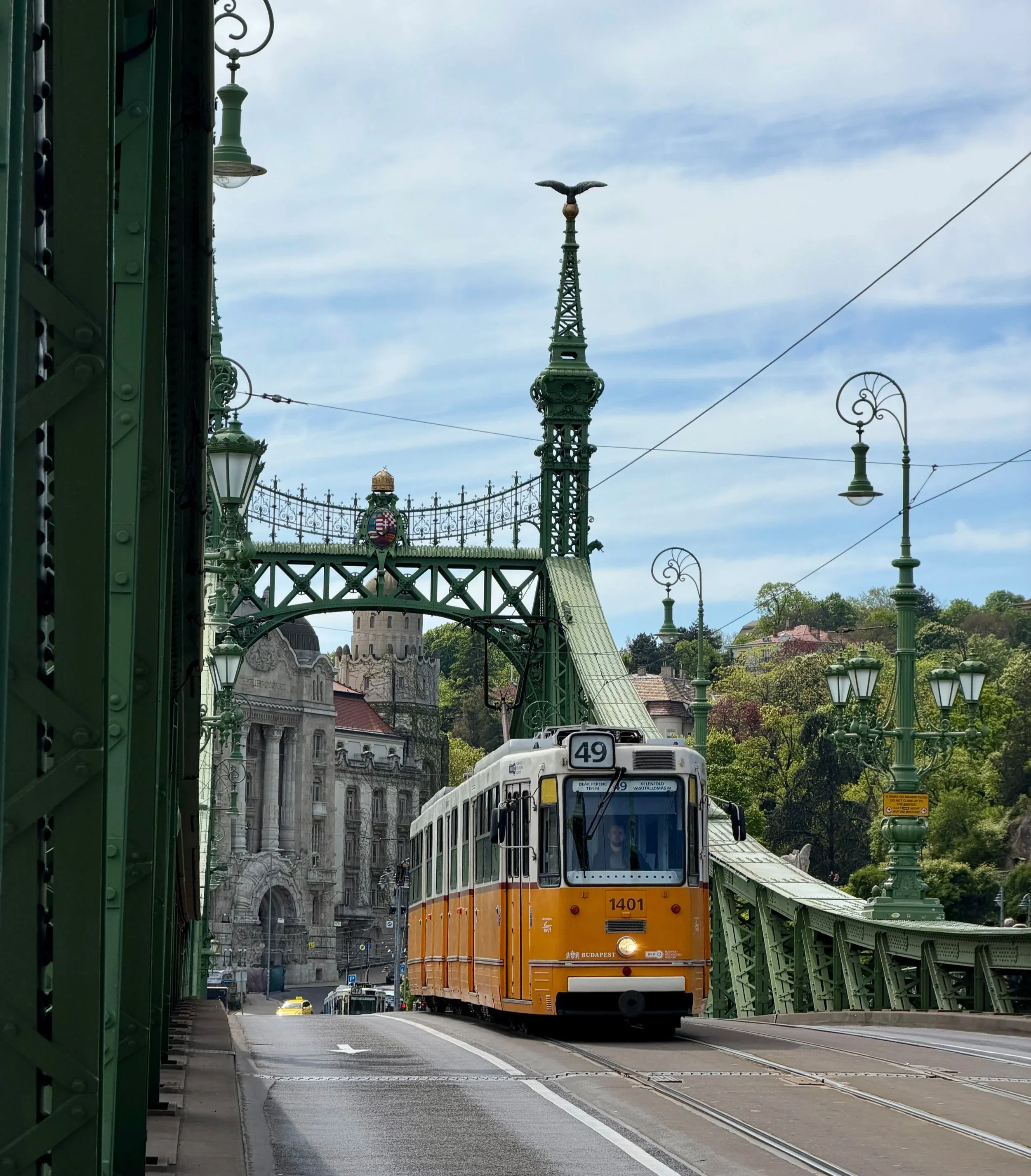
Liberty Bridge Budapest tram — the classic shot
The Basics — What You Need to Know First
Budapest's public transport is run by BKK — Budapesti Közlekedési Központ, the Centre for Budapest Transport. It covers the entire city with four metro lines, an extensive tram network, buses, trolleybuses, a suburban railway, and a handful of more unusual options including a cogwheel railway, a chairlift, and — genuinely — a children's railway run almost entirely by children.
All of these are covered by the same ticket and pass system. One ticket, one pass, the entire network. This is important and worth remembering.
The network runs from approximately 4:30am to around 11:30pm on most lines, with night buses covering the gaps through the early hours. Budapest does not have 24 hour metro service but the night bus network is comprehensive enough that getting home after a late evening in the ruin bars is never a problem.

And if you'd rather have a local walk you through where to find all of this in person — plus everything else Budapest has to offer — get in touch about a private tour and I'll build a day around what you actually want to see and taste. 🙂
Let's explore Budapest →The BudapestGO App — Download This Before You Arrive
Before anything else, download the BudapestGO app — the official BKK journey planner and mobile ticket app, available free on both iPhone and Android, fully in English.
Everything you need is inside it. You can plan every journey from door to door, buy every ticket and pass, store them on your phone, and show them to inspectors on screen. No queues at ticket machines, no fumbling with paper tickets, no language barrier at the ticket window.
The app also shows real-time departures, live vehicle locations, and service disruptions — so you always know exactly when your tram or metro is arriving and whether anything has changed.
Download it before you land. Buy your pass on the way from the airport. It is the single most useful practical step you can take before arriving in Budapest and I recommend it to every guest without exception.
Tickets and Passes — What to Buy
This is where most visitors go wrong. Not because the system is complicated — it is not — but because there are several options and choosing the wrong one costs time and money.
Single Ticket
A single ticket covers one uninterrupted journey on one line or vehicle. If you change lines — metro to tram, bus to metro — you need a new ticket for each vehicle. Currently costs 500 HUF. If you buy it on the vehicle from the driver rather than in advance, it costs 700 HUF — significantly more. Always buy in advance, at a ticket machine, or on the BudapestGO app.
10 Journey Ticket Book
Ten single tickets in one purchase for 4,500 HUF — 450 HUF per journey, a small saving on individual tickets. Useful if you prefer paper tickets or want to share tickets between members of your group.
24 Hour Travel Pass
Unlimited travel on all BKK vehicles for 24 hours from the moment of first validation. Currently costs 2,750 HUF — roughly 9 USD. If you are making more than three or four journeys in a day, which most visitors do, this pays for itself very quickly. Recommended for visits of one or two nights.
72 Hour Travel Pass
Unlimited travel for 72 hours from first validation. Currently costs 5,750 HUF — roughly 18 USD. For a three to four day visit this is almost always the best value option and the one I recommend most consistently to guests.
Buy it on the BudapestGO app before you even land, validate it on your first journey, and forget about tickets for the rest of your stay. This is the correct approach for most visitors to Budapest.
Airport Ticket
A special ticket for the 100E express bus between Budapest Airport and Deák Ferenc Square in the city centre. Costs 2,500 HUF one way. Does not cover any other BKK vehicles — you need a separate standard ticket or pass for onward travel. I cover the full airport journey in my Budapest Airport guide.
Validation — The Most Important Thing
Budapest operates on a proof of payment system — there are no barriers on trams, buses, or trolleybuses, and metro barriers are sometimes open. This means it is physically possible to board without a valid ticket. It also means that ticket inspectors operate across the entire network and check tickets regularly.
The fine for travelling without a valid ticket is serious — 12,000 HUF if paid on the spot or within two working days, rising to 25,000 HUF if paid later, and 50,000 HUF beyond 30 days. Inspectors check tourists and locals equally and consistently.
Always validate your ticket.
On the metro, insert your paper ticket into the orange validation machine at the entrance before going down to the platform. Passes are tapped or presented at the reader. On trams, buses, and trolleybuses, validate your ticket in the machines inside the vehicle immediately after boarding. If you are using the BudapestGO app, open your mobile ticket before boarding and have it ready to show.
The Metro — Four Lines, Everything Connected
Budapest has four metro lines, each colour coded and numbered, covering the most important destinations for visitors.
Metro Line 1 — Yellow
The oldest metro line in continental Europe — older than the London Underground, opened in 1896 for the Hungarian Millennium celebrations — runs directly under Andrássy Avenue from Vörösmarty Square in the city centre to Heroes' Square and the City Park beyond.
This line is a historical experience in itself. The stations are small, beautifully preserved, and completely unlike any other metro station you have been in. The trains are tiny — two carriages, no connecting doors — and the whole thing feels more like a Victorian funicular than a modern metro system.
Use it to reach: Andrássy Avenue, the Opera House, Heroes' Square, Széchenyi Thermal Bath, the Museum of Fine Arts, the City Park.
Metro Line 2 — Red
The main east-west line, crossing the Danube and connecting Pest with Buda. The most useful line for reaching Buda Castle, Déli railway station, and Keleti — the main international railway station on the Pest side.
Use it to reach: Keleti railway station, Blaha Lujza Square, Deák Ferenc Square, the Danube crossing to Buda, Déli railway station for trains to western Hungary.
Metro Line 3 — Blue
The longest metro line, running north to south through Pest. Recently renovated with new trains and updated stations. Covers several important destinations including Nyugati railway station.
Use it to reach: Nyugati railway station, Corvin-negyed, Ferenc körút, Kálvin Square.
Metro Line 4 — Green
The newest line running from Keleti railway station in the east to Kelenföld in the south of Buda. Clean, modern, and fast — a noticeably different experience from the older lines.
One important detail that most visitors do not know: if your journey involves changing between metro lines underground — at Deák Ferenc Square, Keleti or Kálvin Square — you do not need a new ticket for each line. As long as you stay inside the paid zone and do not exit through the gates, a single ticket covers your entire underground journey across multiple metro lines. The moment you exit and come back in, you need a new ticket.
The Trams — The Most Beautiful Way to Travel
Budapest's tram network is extensive and, on certain routes, genuinely spectacular. Trams run frequently, cover areas the metro does not reach, and are in many ways the most pleasant way to move through the city.
Tram 2 — The Most Beautiful Tram Ride in Europe
I say this without reservation. Tram 2 runs along the Pest embankment of the Danube — from Jászai Mari Square in the north to Közvágóhíd in the south — with uninterrupted views of Buda Castle, the Chain Bridge, the Parliament, the Elizabeth Bridge, and the Gellért Hill for the entire journey.
Travel companies charge significant amounts for Danube river cruises that offer similar views from water level. Tram 2 offers those views from a different angle, running every few minutes throughout the day, included in your travel pass at no extra cost.
Board at Jászai Mari Square and ride south. Sit on the right hand side for the Buda views. Do not look at your phone.
This is my single most consistent recommendation to every visitor I guide. It is included in your travel pass, takes twenty minutes, and produces the kind of views that make people go quiet.
Tram 4 and 6 — The Grand Boulevard Ring
Trams 4 and 6 run along the Nagy körút — the Grand Boulevard — the great ring road of Pest, connecting Buda at the Margaret Bridge with the southern end of the city in a long arc. They run 24 hours a day, every few minutes, and cover a huge number of useful destinations including the Great Market Hall, Keleti railway station area, and Nyugati railway station.
If you are lost in Pest and need to reorient, tram 4 or 6 will get you somewhere useful within minutes.
Tram 19 and 41 — Along the Buda Embankment
The Buda-side equivalent of Tram 2 — running along the Buda bank of the Danube with views across to the Pest embankment and Parliament. Less famous than Tram 2 but equally beautiful from the other direction and almost entirely free of tourists.
Buses and Trolleybuses
Budapest's bus network covers the areas that trams and metro do not reach — primarily residential neighbourhoods, the Buda Hills, and the outer districts. For most visitors staying in the centre, buses are less essential than trams and metro, but there are a few routes worth knowing.
Bus 16 and 16A — connect the city centre with Buda Castle, running across the Chain Bridge and up to the Castle District. A useful and queue-free alternative to the funicular.
Bus 100E — the express airport bus connecting Budapest Airport with Deák Ferenc Square in the city centre. Costs 2,500 HUF with a separate airport ticket. The most direct public transport connection from the airport — I cover this fully in my Budapest Airport guide.
Trolleybuses — electric buses running on overhead wires, operating in a limited area of inner Pest. Covered by the same tickets and passes as everything else. Useful for reaching certain addresses in the VII and VIII districts.
Special Lines — The Ones Worth Knowing About
The Funicular
The castle hill funicular connects the Chain Bridge with the Buda Castle terrace — a two minute ride up a steep hill that has been operating since 1870. It is covered by a separate ticket rather than the standard BKK pass and has queues in summer that can stretch to 30 minutes or more.
Honest local verdict: the views from the top are worth seeing but the funicular is not the only way to get there. Bus 16 goes to the same place with no queue. Walking up from the Vienna Gate on the north side of the Castle Hill takes about ten minutes through streets that are more interesting than the funicular queue anyway. Use the funicular once if you want the experience — but do not let the queue eat your afternoon.
The Cogwheel Railway
A rack railway running from Városmajor in Buda up into the Buda Hills — covered by standard BKK passes, completely unknown to most visitors, and one of the most pleasant ways to spend an hour in Budapest if you want to escape the city centre without leaving it entirely.
The Children's Railway
A narrow gauge railway running through the Buda Hills, staffed almost entirely by children aged ten to fourteen in full railway uniforms, supervised by adult professionals. One of the most genuinely unique things you can do in Budapest and one that almost no visitor knows exists.
The children operate the stations, check tickets, wave the departure signal, and take their responsibilities with an absolute seriousness that is simultaneously charming and impressive. The railway runs through beautiful forested hills with several stops where you can walk to viewpoints and forest paths.
Covered by a separate ticket rather than standard BKK passes. Worth every forint.
Practical Tips
Download the BudapestGO app before you arrive. Buy your 72 hour pass on the app the moment you land. It is the single most useful practical step you can take and it takes two minutes.
Validate every time. Even if the barrier is open. Even if nobody else seems to be doing it. The fine starts at 12,000 HUF and the inspectors are consistent.
Tram 2 is not optional. Do it on your first day. Do it at sunset if you can. Do it twice if you have time.
The metro is fastest, the tram is best. For pure speed, take the metro. For the experience of moving through Budapest — for seeing the city rather than tunnelling under it — take the tram.
The BudapestGO app works perfectly for journey planning. Enter your destination, choose public transport, and it will give you accurate real-time directions including which stop to board at, which direction to travel, and when the next vehicle arrives. Use it without hesitation.
Stand on the right on escalators. This is not a suggestion. Hungarians walk on the left side of escalators and stand on the right. Standing on the left will result in a polite but firm request to move. Stand on the right.
Night buses run when the metro does not. After approximately 11:30pm, night buses — identified by route numbers starting with 9 — cover the main routes. They run less frequently than daytime services but reliably enough that getting home from a late evening is always manageable.
One Last Thing
Budapest's public transport is not just a way to get from one place to another. It is part of the city — the yellow metro cars on Line 1 that have been running since 1896, the tram along the Danube embankment, the cogwheel railway climbing into the Buda Hills. Using it properly is part of experiencing Budapest properly.
Download the BudapestGO app. Buy your 72 hour pass. Sit on the right side of Tram 2. Watch the Parliament go by.
You are doing exactly the right thing.
Explore Budapest With a Local
Public transport will get you to the sights. A private tour will show you what they mean. On my private Budapest city tours we move through the city the way locals do — on foot, by tram, by metro — stopping where the stories are rather than where the crowds are.
You Might Also Enjoy:
Etyek's Best-Kept Secret Isn't the Wine, It's the Ham
Hungarian Grand Prix 2026: A Local's Guide to the 40th Anniversary Race
