The Kazinczy Street Synagogue: Budapest's Hidden Orthodox Jewel
By Kata | katabudapest.com | Published June 2026
Mostvisitors who come to Budapest's Jewish Quarter make a beeline for the Dohány Street Synagogue — and rightly so, it's the largest in Europe and absolutely worth seeing. But just a few minutes' walk away, tucked into a narrow street lined with ruin bars and street-food stalls, sits a building I love taking my guests to even more: the Kazinczy Street Synagogue. It's quieter, smaller, and in my opinion one of the most beautiful interiors in the whole city. Let me tell you why it deserves a place on your Budapest itinerary.
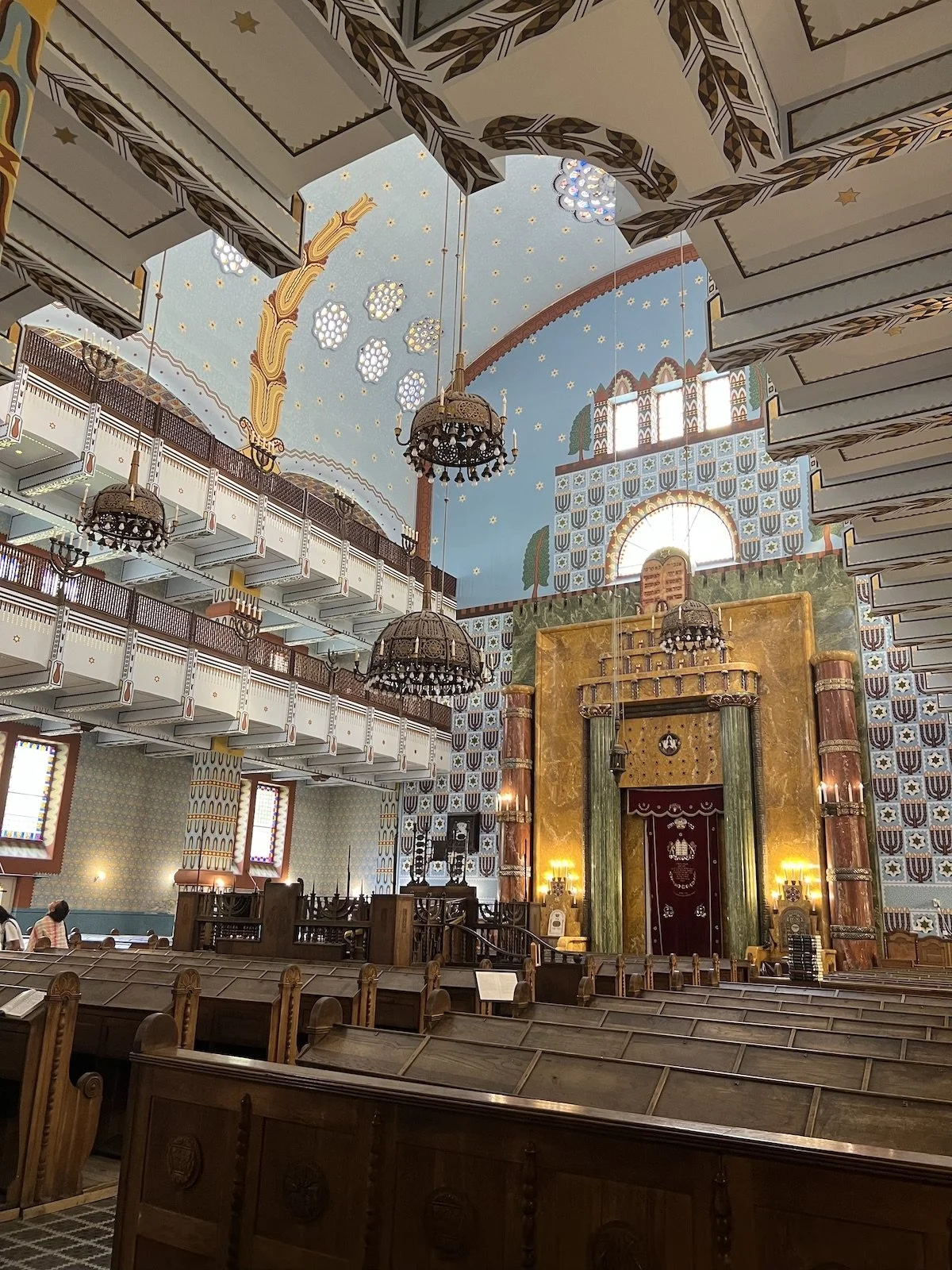
Ornate blue Art Nouveau interior of the Kazinczy Street Synagogue
A synagogue built for the most traditional community
To understand Kazinczy Street, you have to understand a turning point in Hungarian Jewish history. At a congress in 1868–69, the Jewish community of Pest split into three branches: the Neolog (the more reform-minded), the Status Quo Ante (those who wished to "stay as before"), and the Orthodox — the most tradition-bound of the three. The grand Dohány Street Synagogue served the Neolog community. The Orthodox needed a home of their own, and Kazinczy Street is the result
The synagogue was built between 1912 and 1913, designed by the brothers Sándor and Béla Löffler, and it's considered one of the finest examples of Hungarian synagogue architecture from the years just before the First World War. What I always point out to my guests is that this wasn't built as a stand-alone monument — it was the heart of a whole living complex, with a school, a Talmud school, communal headquarters, a kindergarten, a kosher butcher, and a ritual bath. This was a neighborhood designed for an entire way of life.
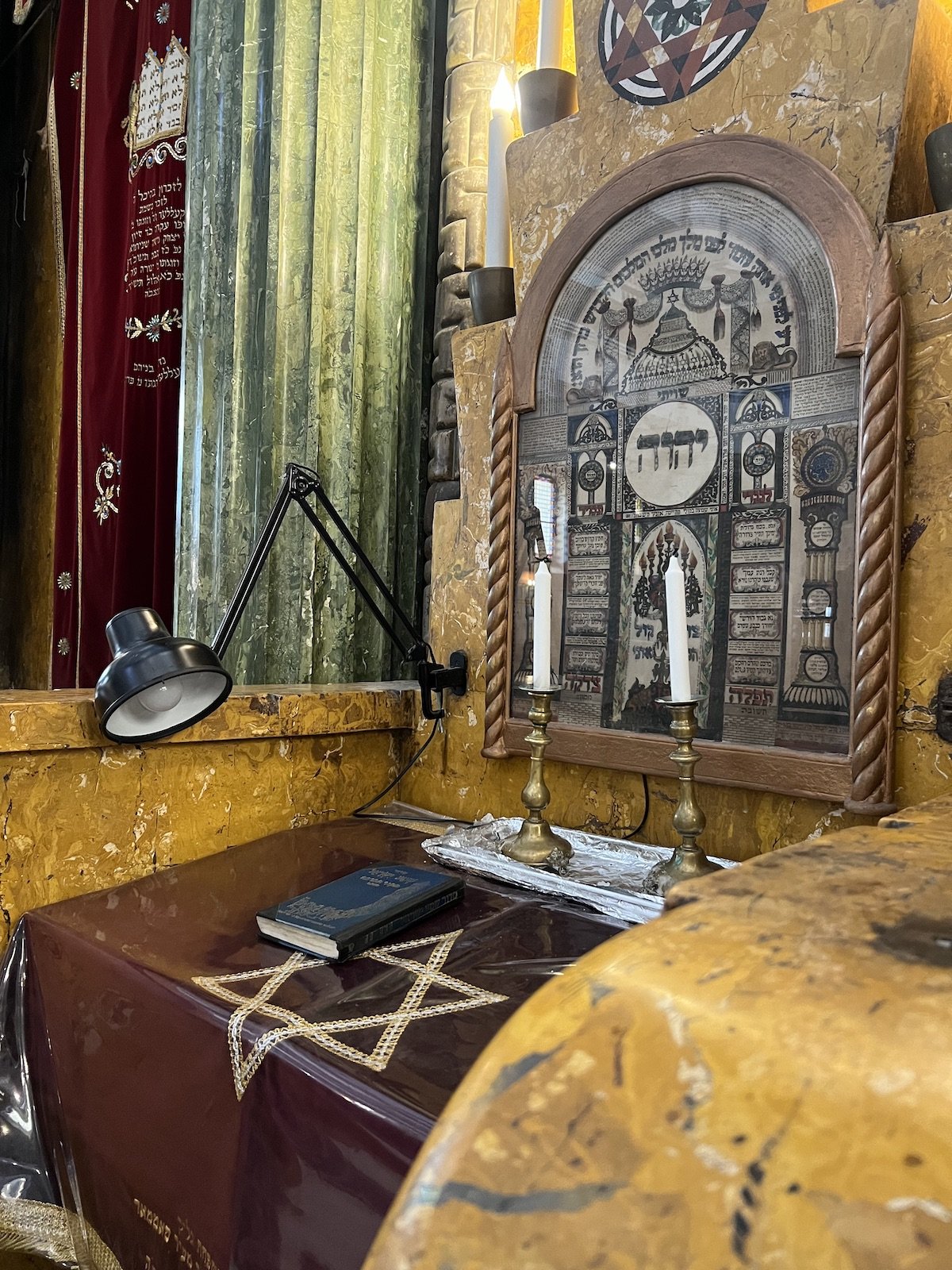
A Quiet Corner of the Kazinczy Street Synagogue
Step inside — this is where it takes your breath away
From the street, the façade is striking but restrained, squeezed between its neighbors. Then you walk in, and everything changes.
The interior is Art Nouveau at its most joyful: walls washed in a deep, glowing blue, intricate stencil work, and ornate stonework framing the windows. Those stained-glass windows are the work of Miksa Róth, the celebrated mosaic and glass artist whose work you'll find in some of Budapest's most important buildings. In the center of the space stands the bimah, the Torah-reading platform — its central position is a hallmark of Orthodox tradition, and it's one of the easiest ways to read the building's faith in its very layout.
I never rush my guests through this room. It's the kind of place where you want to stand still, look up, and let your eyes travel across the color and detail. Photographs really don't do it justice.
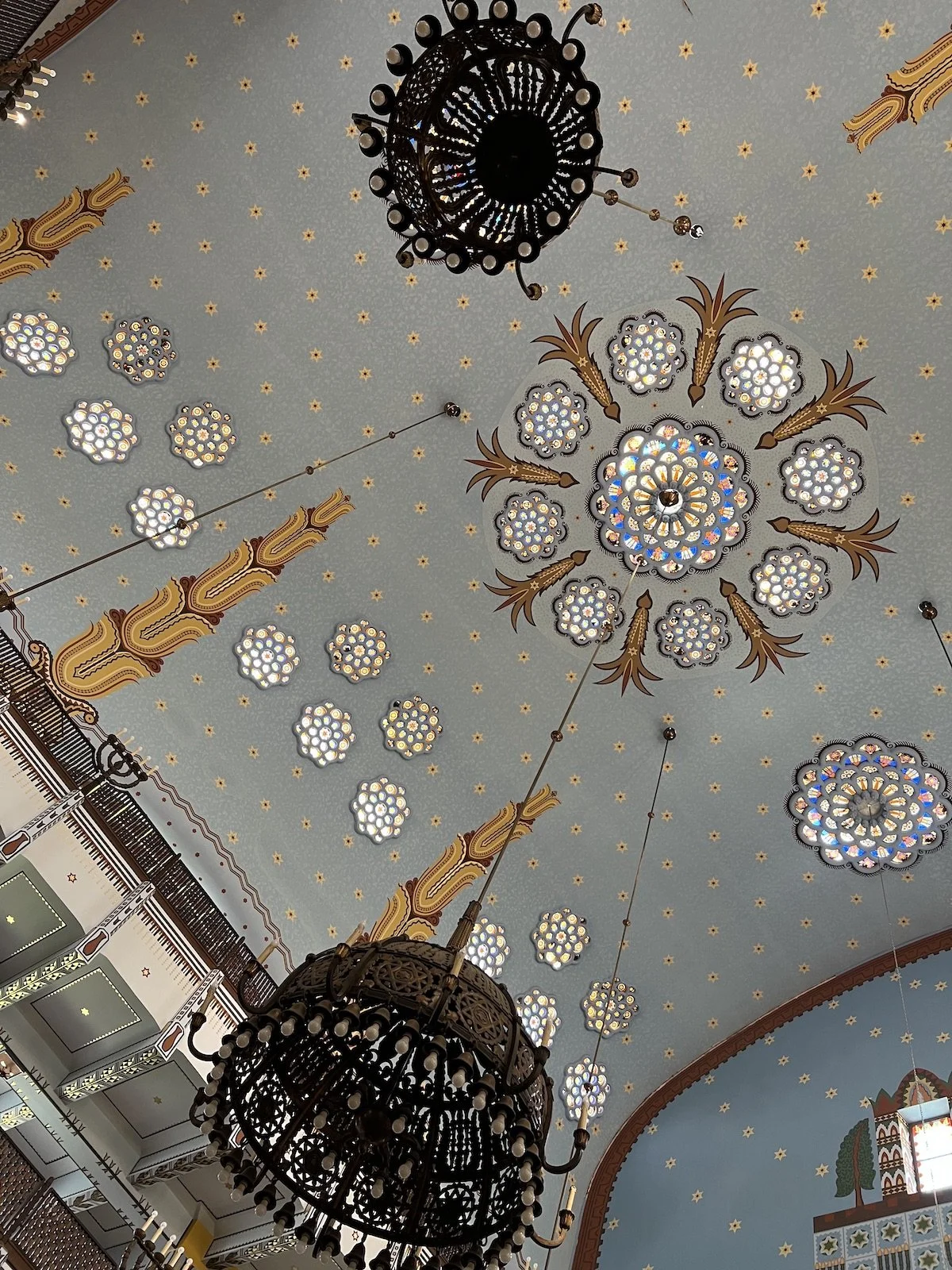
The Breathtaking Ceiling of the Kazinczy Street Synagogue
The kosher heart of the Jewish Quarter
What makes Kazinczy Street special isn't only the synagogue itself — it's that the surrounding complex is still living, breathing Jewish life. This is where you'll find Budapest's historic mikveh (ritual bath), and the area is dotted with kosher kitchens and restaurants, including the well-known Hanna. If you're curious about Jewish food traditions, this little stretch is the place to taste them.
And then there's the wonderful contrast that defines this street today. On one end, kosher kitchens and a working Orthodox synagogue; on the other, some of the city's most famous ruin bars and a constant hum of café energy. I love this about the neighborhood — centuries of history and present-day life pressed up against each other on a single street.
Surviving the darkest chapter
I always make space in my tours to tell this part honestly. During the Second World War, the synagogue stood within the boundaries of the Pest ghetto. The building suffered damage and loss, and at one low point was even used as a stable. That it survived at all, was restored, and is once again an active place of worship is part of why standing inside it feels so meaningful. In 1993 the Hungarian Orthodox community was officially reorganized, and the synagogue continues today as the religious and cultural center of Orthodox Jewish life in Budapest.
Dohány or Kazinczy? Why not both
People often ask me which synagogue they should choose. My honest answer: see both if you can — they tell different halves of the same story. Dohány is grand, monumental, the famous one. Kazinczy is intimate, less crowded, and quietly dazzling once you're inside. If you only have time for one and you want a more personal, off-the-tourist-track experience, Kazinczy might just be the one you remember most.
How to visit
The synagogue is at Kazinczy utca 29–31, in the heart of District VII (Erzsébetváros), Budapest's historic Jewish Quarter. It's an easy walk from the Astoria stop on the M2 metro, and the surrounding streets are made for wandering on foot.
A few things to keep in mind: this is an active Orthodox synagogue, so dress modestly, and men will be asked to cover their heads (kippahs are usually provided at the entrance). Out of respect, it's closed to visitors on Saturdays (Shabbat) and on Jewish holidays.
One important note — visiting hours and ticket prices for the smaller Jewish Quarter synagogues change seasonally, and around holidays they can shift at short notice. Before you make a special trip, it's always worth confirming the current opening times. This is exactly the kind of detail I keep track of for my guests, so if you'd like to see Kazinczy Street the easy way, just reach out and I'll handle the timing for you.
Let me show you the real Jewish Quarter
The Kazinczy Street Synagogue is one of my favorite stops on my Jewish Quarter walks, but the magic is really in the connections between places — the synagogues, the memorials, the kosher kitchens, the hidden courtyards and the stories that tie them together. As a licensed Budapest guide, I'd be delighted to walk this neighborhood with you and bring its history to life at your own pace.
If you're planning a trip to Budapest and want to explore the Jewish Quarter with a local who knows it inside and out, get in touch with me — I'd love to show you around.
