The Shoes on the Danube: Budapest's Most Emotional Memorial
By Kata | katabudapest.com | Updated Oct 10, 2026
There is a moment on the bank of the Danube, just north of the Parliament building, where people go quiet. It happens almost without exception. They're walking along the promenade, taking in the river and the Buda hills across the water, and then they see them — sixty pairs of shoes, cast in iron, lined up along the edge of the bank as if their owners have just stepped out of them and into the water.
Which, in a way, is exactly what happened.
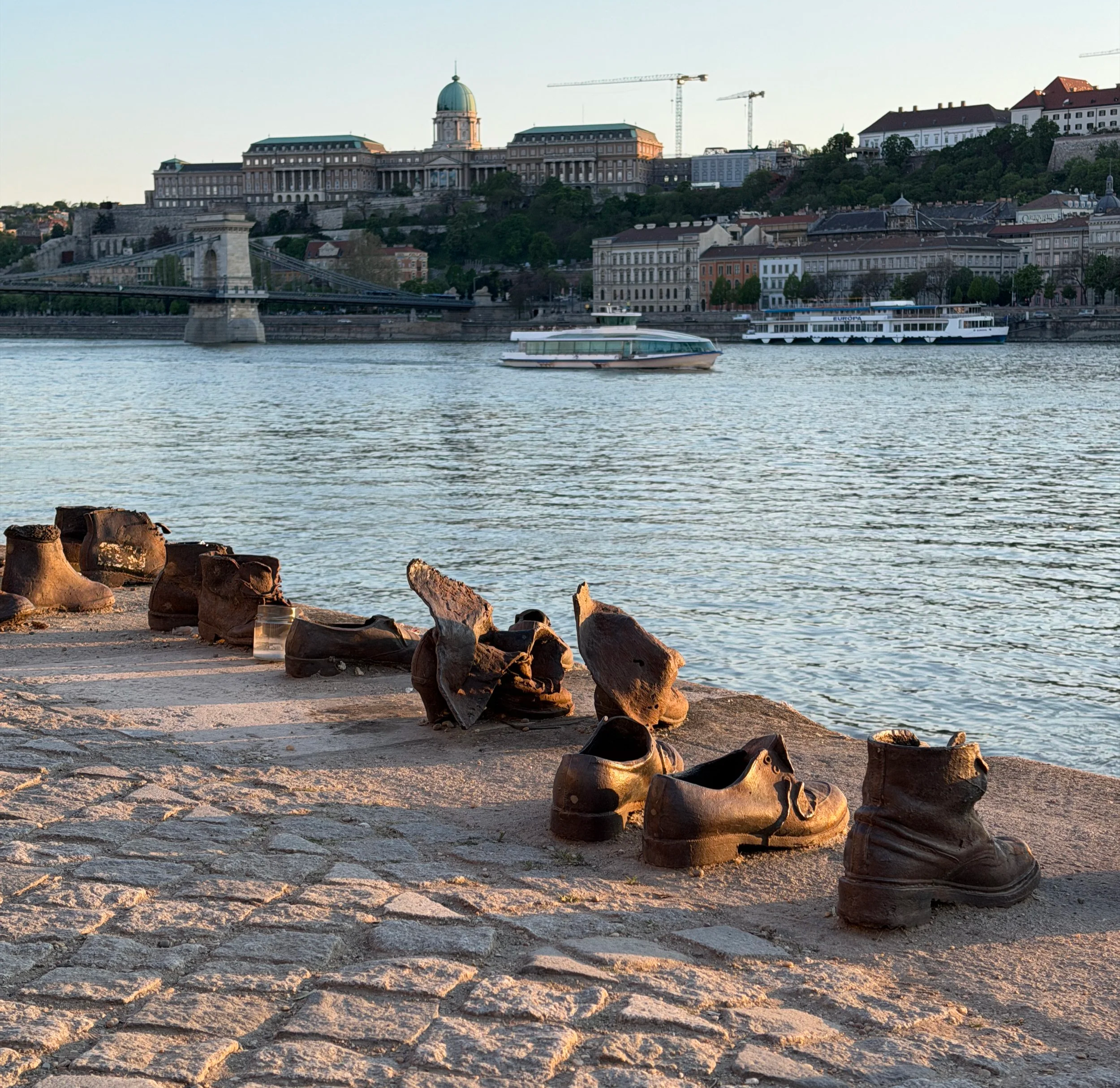
The Shoes on the Danube Bank
What You Are Looking At
The Shoes on the Danube Bank is a memorial created by film director Can Togay and sculptor Gyula Pauer, installed on April 16, 2005. The shoes — men's shoes, women's shoes, children's shoes — represent the Jewish men, women and children who were brought to this spot by Hungarian Arrow Cross militiamen in the winter of 1944 and 1945, ordered to remove their shoes, and shot into the Danube.
They were told to remove their shoes first because shoes were valuable. Worth trading, worth selling. Because in the final months of the Second World War, a pair of shoes was worth more to the killers than the life of the person wearing them. The bodies were carried away by the river. The shoes were taken. And for decades, the riverbank where it happened looked like any other stretch of the Danube.
Most of the murders took place around December 1944 and January 1945, when Arrow Cross militia took as many as 20,000 Jews from the newly established Budapest ghetto and executed them along the river bank. The Danube became so associated with these killings that it was referred to — quietly, grimly — as "the Jewish Cemetery" during that dark winter.

Ready to discover Budapest’s Jewish Quarter with a licensed local guide?
Book your private tour today! →Why Sixty Pairs
The number sixty was not chosen randomly. It reflects the 600,000 Hungarian Jews who died during the Second World War, and the memorial was created sixty years after the war ended. Every detail was considered. Every decision carries meaning.
Why Shoes
The decision to represent the victims through their shoes rather than through faces, names or figures was an act of quiet genius. Shoes are intimate objects. They carry the shape of the person who wore them — the way they walked, the wear on the sole, the looseness of the lace. A shoe is evidence of a life in motion.
Gyula Pauer cast sixty pairs in iron, each one different. There are work boots and heeled shoes, small children's shoes and a baby's bootie. Some are placed neatly together. Some are slightly apart, as if mid-step. The iron has rusted and weathered over the years, which only adds to the weight of them.
There is no face, no name on each shoe. Just the shoe itself — its size, its style, its wear. You fill in the rest. And that process of imagining is, in a way, its own form of remembrance.
Standing in front of them, you don't need to know the history to feel something. But knowing the history changes you.
The Arrow Cross
Most visitors to Budapest know about the Nazi occupation of Hungary in March 1944 and the subsequent deportation of hundreds of thousands of Hungarian Jews to Auschwitz — one of the fastest and most devastating deportations of the entire Holocaust, carried out in a matter of weeks.
What fewer people know is what happened after the Soviet army began closing in and the deportations were halted. In October 1944, the Arrow Cross — Hungary's own fascist party, fanatically antisemitic and ferociously violent — seized power in Budapest with German backing. In the chaos and terror of the final months of the war, as the city was being encircled, they carried out massacres along the Danube bank.
This is sometimes the harder part to sit with. The Arrow Cross were not distant occupiers. They were Hungarian. These were Hungarian citizens killing their neighbours, in their own city, in the final desperate months of a war that was already lost. That fact sits heavily in Hungarian memory and it is part of why this memorial matters so much.
In February 1945, Soviet forces liberated Budapest. During the siege, extraordinary individuals risked everything to save as many Jewish lives as possible. Swedish diplomat Raoul Wallenberg issued thousands of protective passports and set up safe houses across the city, saving tens of thousands of lives. Swiss diplomat Carl Lutz — operating out of the former American Embassy on Szabadság tér, just a short walk from where the shoes now stand — issued letters of protection to over 60,000 Hungarian Jews, making his operation one of the largest rescue efforts of any individual during the entire Second World War. Both men put their lives and careers on the line in the final desperate months of the war. Their efforts saved tens of thousands. But tens of thousands more did not survive.
How to Visit
The memorial is on the Pest bank of the Danube, between the Parliament building and the Chain Bridge — about 300 metres south of Parliament. It is outdoors, always open and always free. The easiest way to reach it is by Tram 2, the scenic river tram, to the Kossuth Lajos tér stop, then a short walk south along the promenade.
There is no entrance, no ticket, no guided introduction. You simply arrive and you stand there.
People leave things. Candles, flowers, small stones in the Jewish tradition of mourning. On significant anniversaries the shoes are sometimes filled with flowers or lit from within by candles placed inside them, and the effect is quietly devastating.
I always pause here on my tours. Not because it's on a checklist but because I think it's one of the most important things Budapest asks you to witness. The city is full of beauty — the Parliament, the bridges, the thermal baths, the ruin bars, the grand cafés. All of that is real and all of that is worth your time.
But Budapest is also a city that has survived extraordinary darkness, and the Shoes on the Danube are one of the places where that darkness is impossible to look away from.
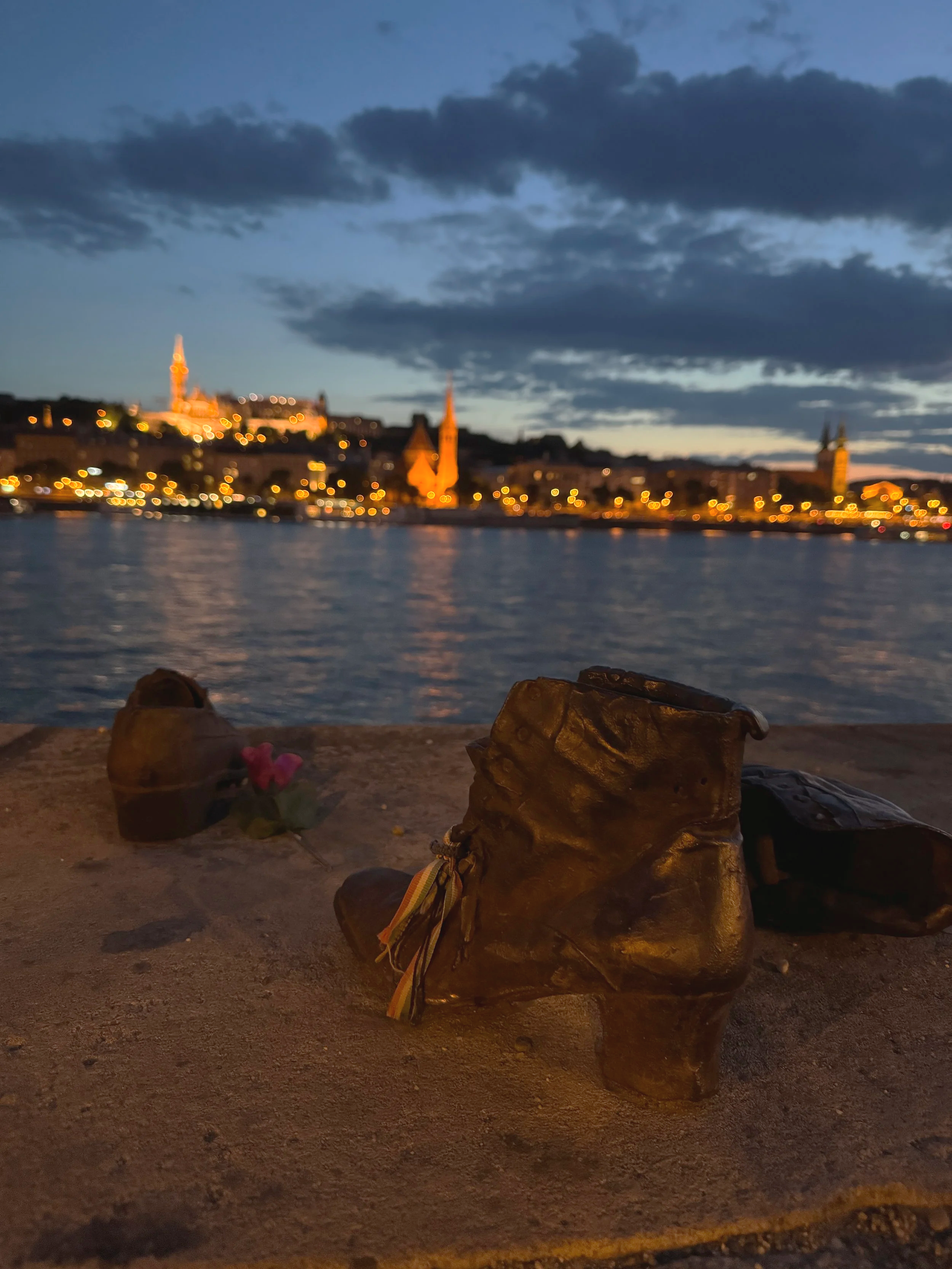
The memorial at night
A Note Before You Go
If you visit with children, it is worth thinking about how to approach it. The memorial is not graphic, but it is powerful, and children often feel it instinctively even without fully understanding the history. In my experience that instinct is worth honouring rather than rushing past.
Go in the late afternoon if you can, when the light on the river is soft and the Parliament glows behind you. Give yourself more time than you think you need. And when you get there, just be still for a moment.
Some places in this city ask you to celebrate. This one asks you to remember. Both matter.
If you'd like to visit the Shoes on the Danube as part of a deeper walk through Budapest's Jewish history and the story of the city during the Second World War, that is one of the tours I care most about. Come and walk it with me.
Enjoyed this one? A few more from the blog you'll probably want to read next:
Best Goulash in Budapest: Where Locals Actually Eat It
Entering Hungary as a Non-EU Citizen in 2026: What You Actually Need to Know
20 Unique Things to Buy in Hungary That Locals Actually Love (Not Fridge Magnets)
Silvanus Hotel Visegrád: A Relaxing Lunch Stop with Danube Views
