10 Hungarian Cakes You Absolutely Have to Try (A Tour Guide Who Bakes Tells All)
By Kata | www.katabudapest.com | Updated, Oct 7, 2026
There's a moment that happens on almost every food tour I lead.
We're standing in front of a cukrászda window — one of Budapest's traditional pastry shops — and my guest goes quiet. Not because they're bored. Because they weren't expecting it to look like that. The Dobos Torte with its caramel crown. The Esterházy with that impossibly precise spiderweb icing. The Krémes wobbling gently behind the glass, dusted in powdered sugar, looking like it was assembled that morning by someone who genuinely cares.
Hungarian pastry culture doesn't get the international attention it deserves. People come to Budapest for the baths, the architecture, the ruin bars — and then they stumble into a café and discover that the cake scene alone could justify the trip.
Hungary sits at a fascinating crossroads of culinary influence. Ottoman spice traders, Viennese court bakers, Austro-Hungarian aristocracy, the rich Jewish pastry tradition of old Budapest — they all left something behind in Hungarian kitchens. The result is a dessert culture that is layered (sometimes literally — six, seven, eight layers of sponge) with centuries of history.
The 10 Hungarian cakes at a glance:
Dobos Torte: thin sponge layers, chocolate buttercream and a crackly caramel top.
Esterházy Torte: nutty meringue layers, buttercream and feathered white icing.
Rigó Jancsi: a chocolate cube with a love story behind the name.
Somlói Galuska: three sponges, rum, walnuts, chocolate sauce and whipped cream.
Krémes: vanilla cream between crisp layers of pastry.
Zserbó: walnut, apricot jam and chocolate, a Christmas favorite.
Puncstorta: rum-soaked sponge under bright pink icing.
Gundel Palacsinta: walnut-filled crêpes with warm chocolate sauce.
Gesztenyepüré: sweet chestnut purée with whipped cream.
Rákóczi Túrós: curd cheese on pastry with meringue and apricot jam.
1. Dobos Torte — Hungary's Most Famous Cake, and the One That Changed Everything
If you try only one Hungarian cake in your life, the Dobos Torte should probably be it.
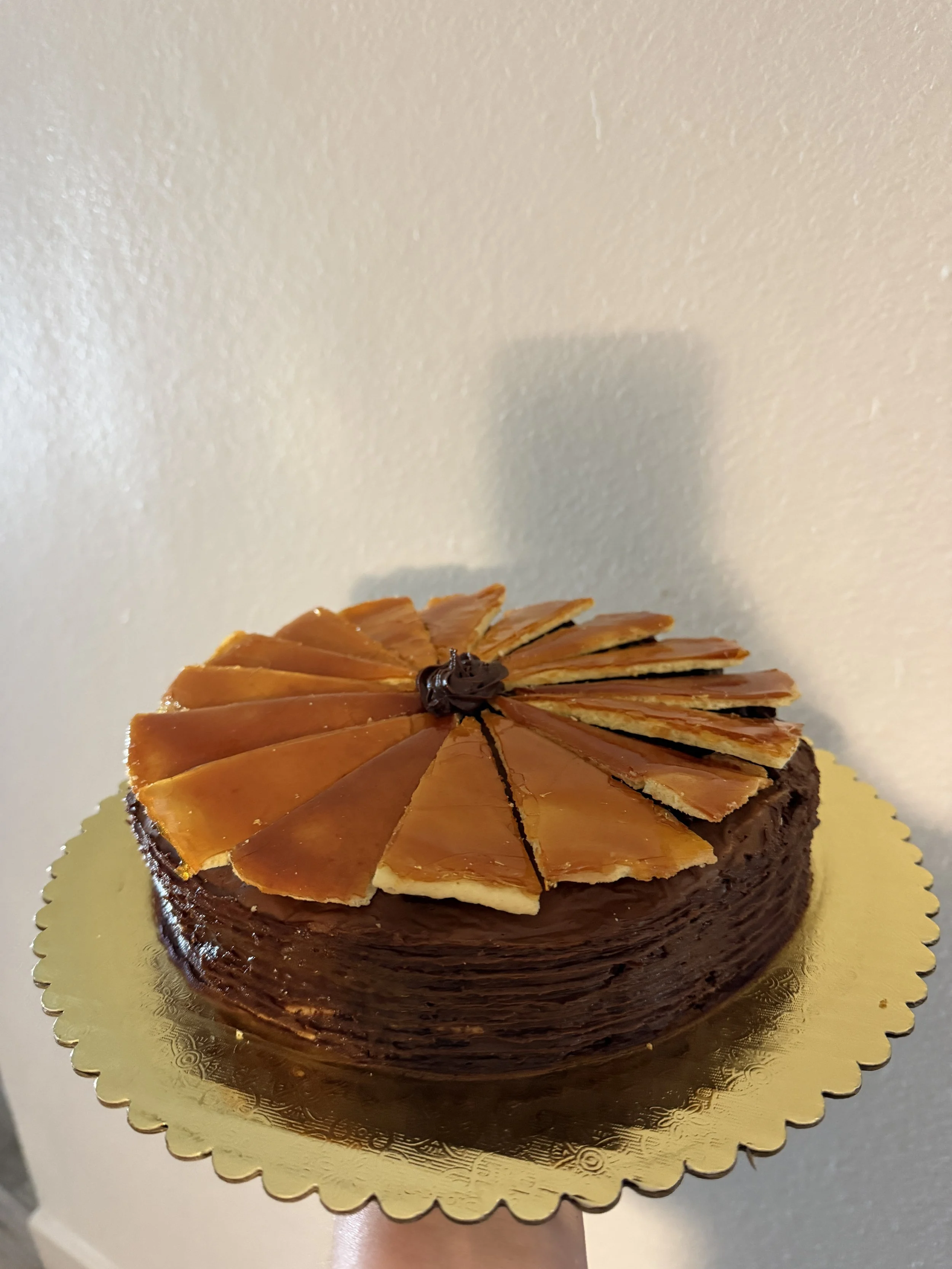
What it is: Six ultra-thin sponge layers sandwiched with chocolate buttercream, the whole thing wrapped in more chocolate buttercream on the sides, and crowned with a top layer of shatteringly thin caramel that crackles when you cut through it. Each slice gets a caramel-dipped triangle standing upright like a crown.
Why it exists: József C. Dobos was a Budapest confectioner who debuted this cake at the National General Exhibition in 1885. The genius wasn't just the taste — it was the engineering. Most cakes of the era spoiled within hours. Dobos solved this with the caramel top layer, which sealed the cream inside and allowed the torte to travel and keep for days. He sent it to Emperor Franz Joseph and Empress Sisi. They loved it. Budapest went wild.
The original recipe was kept secret for years — Dobos only released it publicly when he retired, donating it to the Budapest Confectioners' Guild so it would never be lost. That's how much this cake meant to him. That's how much it still means to Hungary.
Where to try it: Gerbeaud on Vörösmarty Square has been making it for generations.

Would you rather taste these with a local? I'll take you to my favorite cake shops on a private food tour.
Let's taste Budapest together! →2. Esterházy Torte — The Aristocratic One
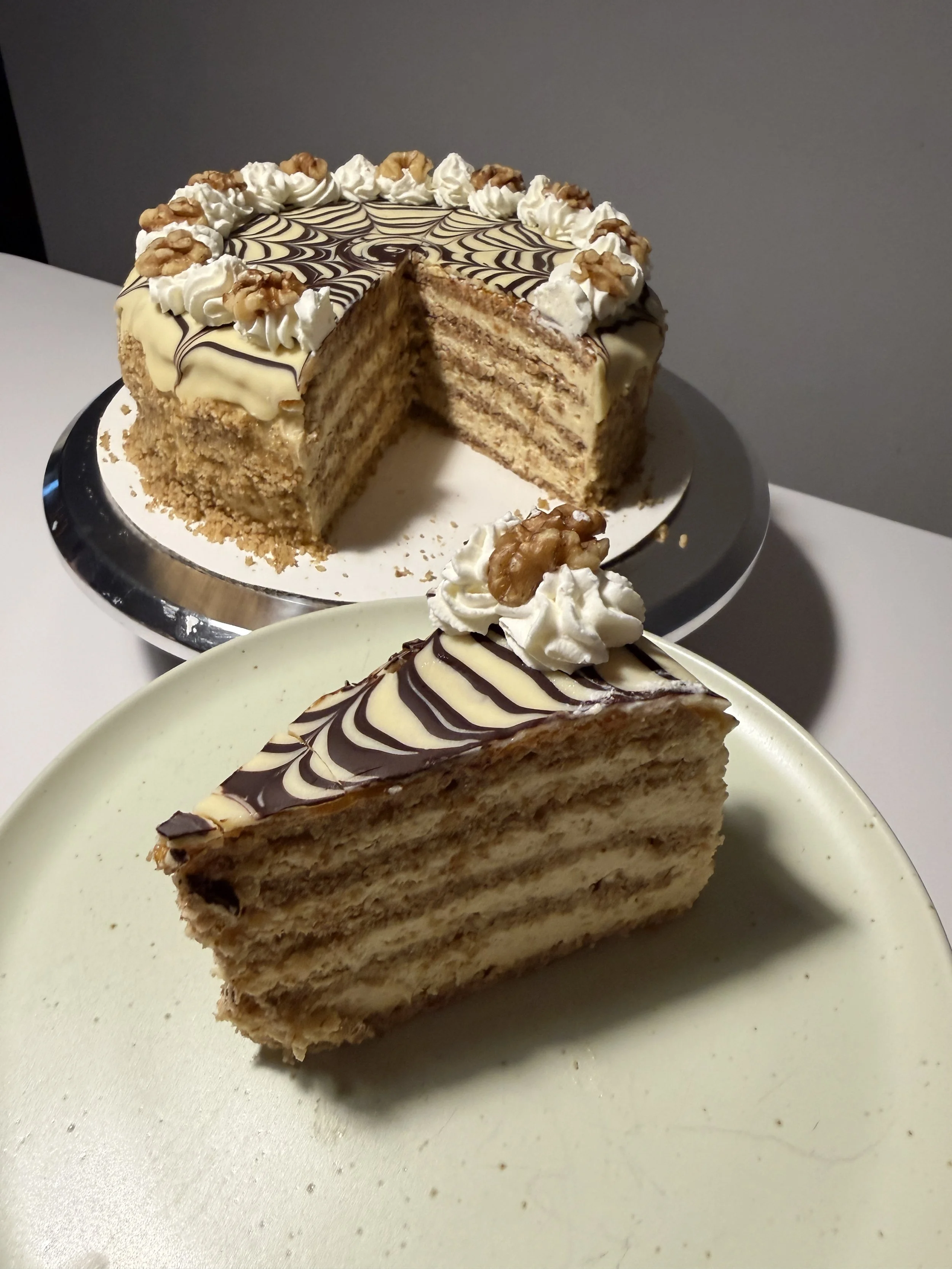
What it is: Alternating layers of almond (or walnut) meringue sponge filled with cognac or vanilla-scented buttercream, iced in white fondant, and decorated with the signature chocolate spiderweb pattern — concentric circles drawn through in alternating directions to create that instantly recognizable feathered effect.
Why it exists: Named for the Esterházy family — one of the wealthiest and most powerful aristocratic dynasties in Habsburg-era Hungary — this cake was designed to impress. It's a showpiece. The decoration alone tells you that: that spiderweb isn't functional, it's a statement. It says someone in the kitchen had the time, skill, and confidence to do something beautiful.
The meringue sponge layers are made with ground nuts rather than flour, which gives them a texture entirely their own — chewy, slightly crisp at the edge, deeply nutty, with a richness that flour-based sponge simply can't achieve.
Where to try it: Any serious cukrászda will have a version. Look for one where the layers are distinct and the spiderweb icing is hand-drawn, not a printed shortcut. The difference is visible — and tasteable.
3. Rigó Jancsi — The Romantic One
What it is: Two layers of dark chocolate sponge encasing a thick, billowing layer of chocolate cream — not buttercream, but a softer, lighter whipped ganache-style filling. The whole square is glazed in dark chocolate. It's intense. It doesn't try to be anything other than what it is.
Why it exists: This cake has one of the best origin stories in Hungarian food history. Rigó Jancsi was a famous Hungarian Romani violinist in the 1890s — charismatic, celebrated, legendarily charming. The story goes that he performed at a dinner attended by Clara Ward, a Belgian princess and American heiress, who was so captivated that she eventually left her husband for him. A Budapest confectioner reportedly created this cake in their honor.
Whether every detail of the story holds up to historical scrutiny is debatable. But the cake is real, it's been on Budapest café menus for over a century, and it is excellent.
Where to try it: Look for it in traditional cake shops rather than modern cafés. It's deeply old-school in the best way — the kind of cake that reminds you Hungarian pastry culture has been doing this for a very long time.
4. Somlói Galuska — The One That Looks Like Chaos but Tastes Like Everything
What it is: Not quite a cake, not quite a trifle — entirely its own thing. Cubes of three different sponges (plain, walnut, and cocoa) soaked in rum syrup, layered with vanilla cream, walnuts, and raisins, drizzled with warm chocolate sauce, and finished with a cloud of whipped cream. It arrives in a glass looking like someone made a magnificent mess. It tastes extraordinary.
Why it exists: It was dreamed up at the Gundel restaurant in the 1950s by head waiter Károly Gollerits and made by pastry chef József Béla Szőcs. It won an award at the 1958 World Expo in Brussels and spread across Hungary almost immediately. The name has nothing to do with the Somló wine region, whatever people assume. It comes from Somlyó Hill near Fót, the pastry chef's home. The story goes that a spelling slip in Brussels turned 'somlyói' into 'somlói', and it stuck.The name comes from Somló Hill, a famous Hungarian wine region — the rum-soaked sponge was inspired by the richness of Somlói wine, and the layered construction was meant to evoke abundance.
Where to try it: Gundel restaurant in City Park serves the original and it's worth the visit for the atmosphere alone. But this is also one of those desserts that neighborhood cafés and home cooks often make brilliantly. Keep an eye out for it on cake trolleys and glass display counters across the city.
5. Krémes — The Everyday Masterpiece
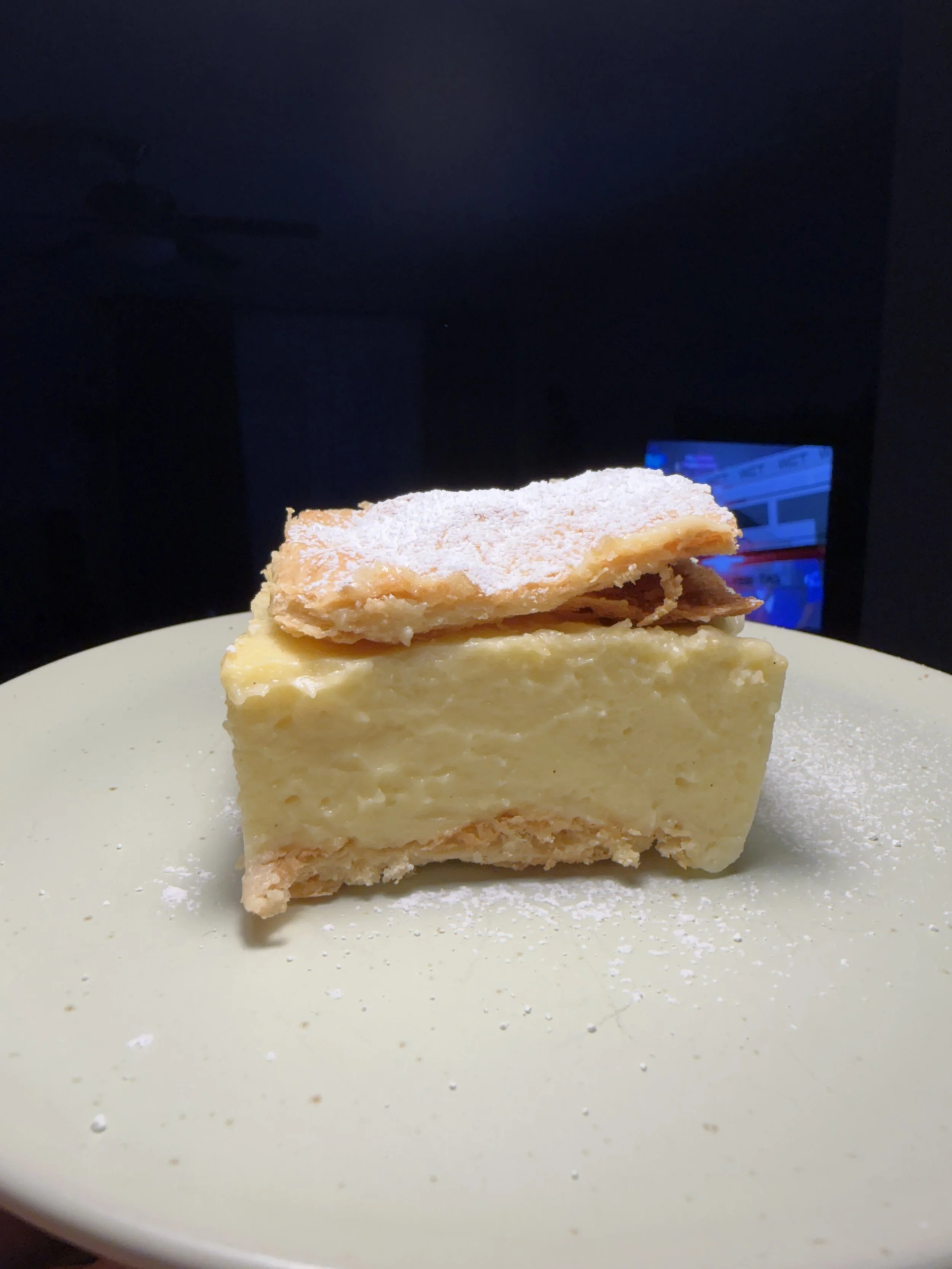
What it is: Two layers of rough puff pastry sandwiching an enormous, pillowy filling of set vanilla cream — barely held together, dusted with powdered sugar on top. It wobbles slightly when you pick up the plate. It's perfect!
Why it matters: Krémes is the everyday cake. Not a special occasion dessert — just something you'd stop for on a Tuesday afternoon at a neighborhood cukrászda. Every Hungarian has strong opinions about whose Krémes is best. It's a deeply personal, slightly tribal thing. Ask a local where to find the best one and you'll get a passionate, immediate answer.
The genius of Krémes is its simplicity — there's nowhere to hide. The cream has to be exactly right: set enough to hold its shape when sliced, then immediately melting on the tongue. The pastry has to stay flaky despite the moisture of the filling. When it all comes together, it's one of the most satisfying things you'll eat in Hungary.
Where to try it: Everywhere. Seriously — try a few different places and you'll immediately understand why Hungarians feel so strongly about this one.
6. Zserbó — The Holiday One
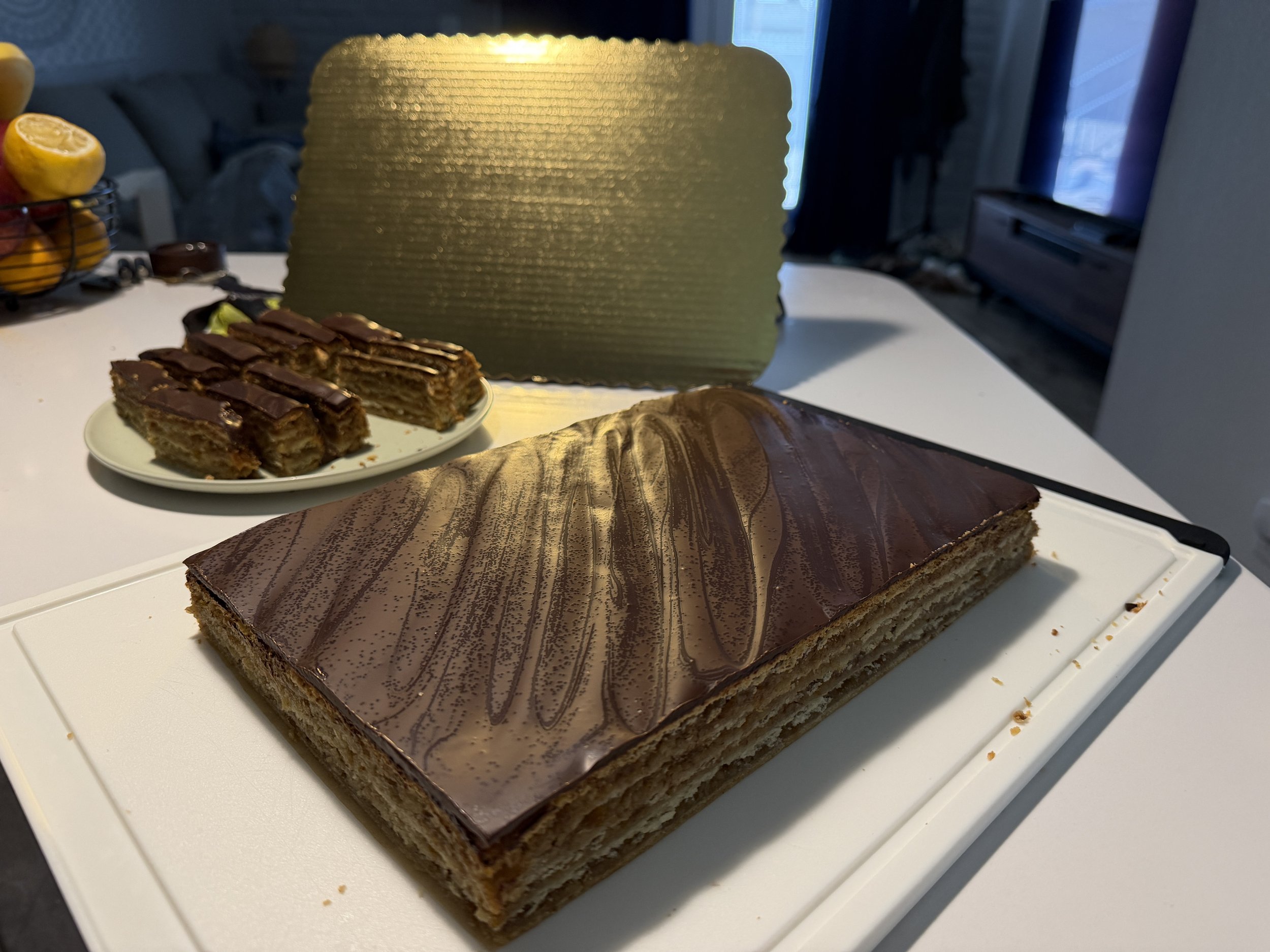
What it is: Layers of short pastry alternating with fillings of ground walnuts and apricot jam, the whole thing glazed with dark chocolate and cut into small squares. Dense, sweet, slightly jammy, very satisfying.
Why it exists: Named after the Gerbeaud patisserie (Zserbó is the Hungarian transliteration of Gerbeaud), where it was popularized in the late 19th century. It became a Hungarian holiday staple — you'll find it at Christmas markets, on festive tables, at family gatherings across the country. It's the cake that every Hungarian grandmother has a version of.
There's something comforting about a cake that has survived this long essentially unchanged. The recipe works. It has always worked. There's no reason to modernize it.
Where to try it: Gerbeaud is the benchmark. Also widely available at Budapest's Christmas markets in December, where it often comes in generous squares alongside mulled wine. Home versions passed down through families are frequently the best versions of all.
7. Puncstorta — The Festive, Joyful One
What it is: Sponge cake soaked in punch-flavored syrup (rum, citrus, and fruit), layered with apricot jam, covered in pink marzipan or fondant, and decorated with candied cherries. It's vivid, sweet, and unapologetically celebratory.
Why it exists: Puncstorta is Hungary's celebration cake — the one for birthdays, name days (a bigger deal in Hungary than most visitors realize), and any occasion that calls for something that looks like a party. The bright pink color is deliberate. This cake is not trying to be subtle.
The rum-citrus punch that saturates the sponge is what makes it — that syrup needs time to work through the layers, which means a properly made Puncstorta is always better on day two. The patience is part of the recipe.
Where to try it: Traditional cukrászdák across Budapest. Look for the bright pink ones in the display case — they're unmistakable and impossible to walk past without smiling.
8. Gundel Palacsinta — Technically a Pancake, But This List Isn't Complete Without It
What it is: Thin crêpes filled with a mixture of ground walnuts, raisins, rum, and orange zest, folded and served with a warm dark chocolate sauce — often flambéed tableside with a small flame. It's theatrical. It's delicious. It occupies the exact intersection of dessert and performance.
Why it deserves a spot here: Gundel Palacsinta is one of Hungary's most iconic sweet dishes, and leaving it off because it's technically not a cake would be missing the point entirely. Created at the Gundel restaurant in the early 20th century by chef Károly Gundel himself, it's been a Budapest institution for over 100 years and has been served to presidents, royalty, and a few million ordinary visitors who just wanted something extraordinary for dessert.
Where to try it: Gundel restaurant in City Park for the original and the full tableside experience — it's a splurge, but for a special evening, absolutely worth it. Some other traditional restaurants serve their own versions, but Gundel is where it was born.
9. Gesztenyepüré — The Winter One That Locals Are Weirdly Protective Of
What it is: Sweetened chestnut purée — cooked chestnuts forced through a ricer into long, light threads, mounded into a soft heap, scented with rum and vanilla, and served with a generous spoonful of whipped cream on top. It's earthy, rich, faintly boozy, and deeply autumnal.
Why Hungarians love it: This is the dessert of October and November, when chestnut roasters appear on Budapest street corners and the city starts to smell like winter. Gesztenyepüré is pure comfort — the kind of thing that tastes like someone's grandmother made it, even when you order it at a café counter. It exists alongside a particular Budapest mood: coats coming out, leaves on the Danube embankment, the long evenings beginning.
It's also a dessert that's extremely hard to find outside Hungary and a handful of Central European neighbors. Eating it here, in season, is genuinely the right way to experience it.
Where to try it: In season (October through December) at any cukrászda. Some serve it year-round using frozen purée, but if you're visiting in autumn, seek out the fresh version.
10. Rákóczi Túrós — The One That Surprises Everyone
What it is: A base of short pastry topped with sweetened túró (a fresh Hungarian curd cheese, somewhere between ricotta and quark), finished with a meringue lattice and apricot jam piped into the diamond shapes the meringue creates. Tangy from the cheese, sweet from the meringue, fruity from the jam, all sitting on that buttery pastry base.
Why it earns the final spot: Because it's the cake that surprises the most visitors. People arrive expecting Hungarian desserts to all be rich, dark, and chocolate-heavy. Rákóczi Túrós is bright and slightly sharp and genuinely refreshing — the fresh curd cheese gives it a lightness that most of the other classics don't have.
Most people assume it's named after Prince Ferenc Rákóczi II. It isn't. It carries the name of János Rákóczi, a master chef who worked with Károly Gundel, and it made its official debut at the 1958 World Expo in Brussels, where it won a gold medal.
Where to try it: Particularly common in neighborhood cukrászdák rather than the major tourist-facing patisseries. Another reason to wander away from the main streets — the further you get from the obvious spots, the more likely you are to find a version made the way it's supposed to be.
Three More Worth Trying
These didn't make the top ten, but you'll see them everywhere, and each one is worth a detour.
Flódni. This is the great cake of Jewish Budapest: four fillings stacked between thin sheets of pastry. Apple, walnut, poppy seed and plum jam, each in its own layer, so every bite tastes a little different. It's rich, dense and not too sweet. You'll find the best ones in and around the Jewish Quarter.
Bejgli. No Hungarian Christmas table is complete without it. Bejgli is a rolled pastry with a thick swirl of walnut or poppy seed filling, sliced into rounds and served with coffee from early December until the last crumb is gone. Every family argues about which filling is better. The honest answer is to have one of each.
Kürtőskalács. You'll smell chimney cake before you see it. Sweet yeast dough is wound around a wooden cylinder, rolled in sugar and turned over hot coals until the outside caramelizes into a crisp, golden shell. Then it's dusted with cinnamon, walnut or cocoa and handed to you warm. Pull it apart in spirals and eat it while you walk. It comes from the Hungarian-speaking Székely region of Transylvania, and it's at its best fresh from a market stall on a cold day.
Where to Actually Find These Cakes in Budapest
Művész Kávéház (Andrássy Avenue) — A classic coffeehouse across from the Opera House, open since 1898. Chandeliers, marble tables and a cake counter with all the classics. It's the perfect stop before or after a walk down Andrássy.
Gerbeaud (Vörösmarty Square) — The grand dame of Budapest patisseries, open since 1858. The location is iconic, the prices reflect it, and the cakes are genuinely good. Worth one visit for the atmosphere alone — the interior is as much the point as the cake.
Central Kávéház (Inner Pest) — A beautifully restored grand café with a wonderful selection and exactly the right old-Budapest atmosphere to eat it in.
One More Thing: You Can't Eat These Alone
Hungarian cakes were designed to be eaten in a kávéház — a coffeehouse — with a strong espresso or a glass of tea. This is not incidental. The bitterness of the coffee is what makes the sweetness of the Dobos work. The light acidity of tea cuts through the richness of a Krémes.
If you're grabbing cake on the go, fine. But if you have time — and in Budapest, you should make time — find a café, sit down, order something to drink, and eat your cake at a table. That's how it was meant to be experienced. That's how Budapest slows down.
Frequently Asked Questions
What is the most famous Hungarian cake? Dobos Torte. It was created by Budapest confectioner József C. Dobos in 1885 and is known for its thin sponge layers, chocolate buttercream and hard caramel top.
What is the difference between Dobos and Esterházy torte? Dobos is sponge and chocolate buttercream with a caramel top. Esterházy is made with nut meringue layers and buttercream, and finished with white icing and a feathered chocolate pattern.
What is krémes? Krémes is a thick layer of set vanilla cream between two sheets of flaky pastry, dusted with powdered sugar. It's the everyday cake Hungarians feel most strongly about.
What does cukrászda mean? It's the Hungarian word for a pastry shop. You'll see it on signs all over Budapest, and it's where locals go for cake.
Where can I try traditional cakes in Budapest? Gerbeaud and Művész Kávéház are classic choices, and Central Kávéház has a lovely old-Budapest atmosphere. For the most local experience, walk into a small neighborhood cukrászda.
What cakes do Hungarians eat at Christmas? Bejgli, a walnut or poppy seed roll, and zserbó, with its layers of walnut, apricot jam and chocolate.
Is chimney cake Hungarian? Yes. Kürtőskalács comes from the Hungarian-speaking Székely region of Transylvania and is sold at markets and street stands all over Hungary.
Can I taste Hungarian cakes on a food tour? Yes. I include pastry shops and cake tastings on my private food tours, with the stories behind each one.
Want to Taste Your Way Through Budapest With a Local? Hungarian cake and café culture is one of my favorite things to explore with visitors — not just the eating, but the stories, the history, and finding the places that most tourists never discover.
If you'd like to experience Budapest's food and pastry scene as part of a private tour, I'd love to show you around. Contact me here!
Enjoyed this one? A few more from the blog you'll probably want to read next:
Where Budapest Really Shops: Inside the Klauzál Square Market Hall
Szimpla Kert: Is It Still Worth Seeing in Budapest?
Why You Should Visit the Citadella for Sunset in Budapest
Kaptafa Brunch: The Jewish Quarter Spot That Makes Breakfast Fun Again
