Fisherman's Bastion, Budapest: A Local Guide's Complete Visitor Guide
By Kata | katabudapest.com | Published Aug 31, 2026
If there's one photo everyone shows me before their trip to Budapest, it's this one: white fairy-tale towers on a hilltop, the Danube and Parliament glowing behind them. That's Fisherman's Bastion (Halászbástya), and I promise it looks even better in person than on your phone — but there's a right way and a wrong way to visit it, and almost every guest I meet is doing it the wrong way without realizing.
Here's everything you actually need to know: the real history behind those towers, when you can visit for free, what the tickets are worth (and when they're not), and how to time your visit so you're not sharing the view with three tour buses at once.
What is Fisherman's Bastion, exactly?
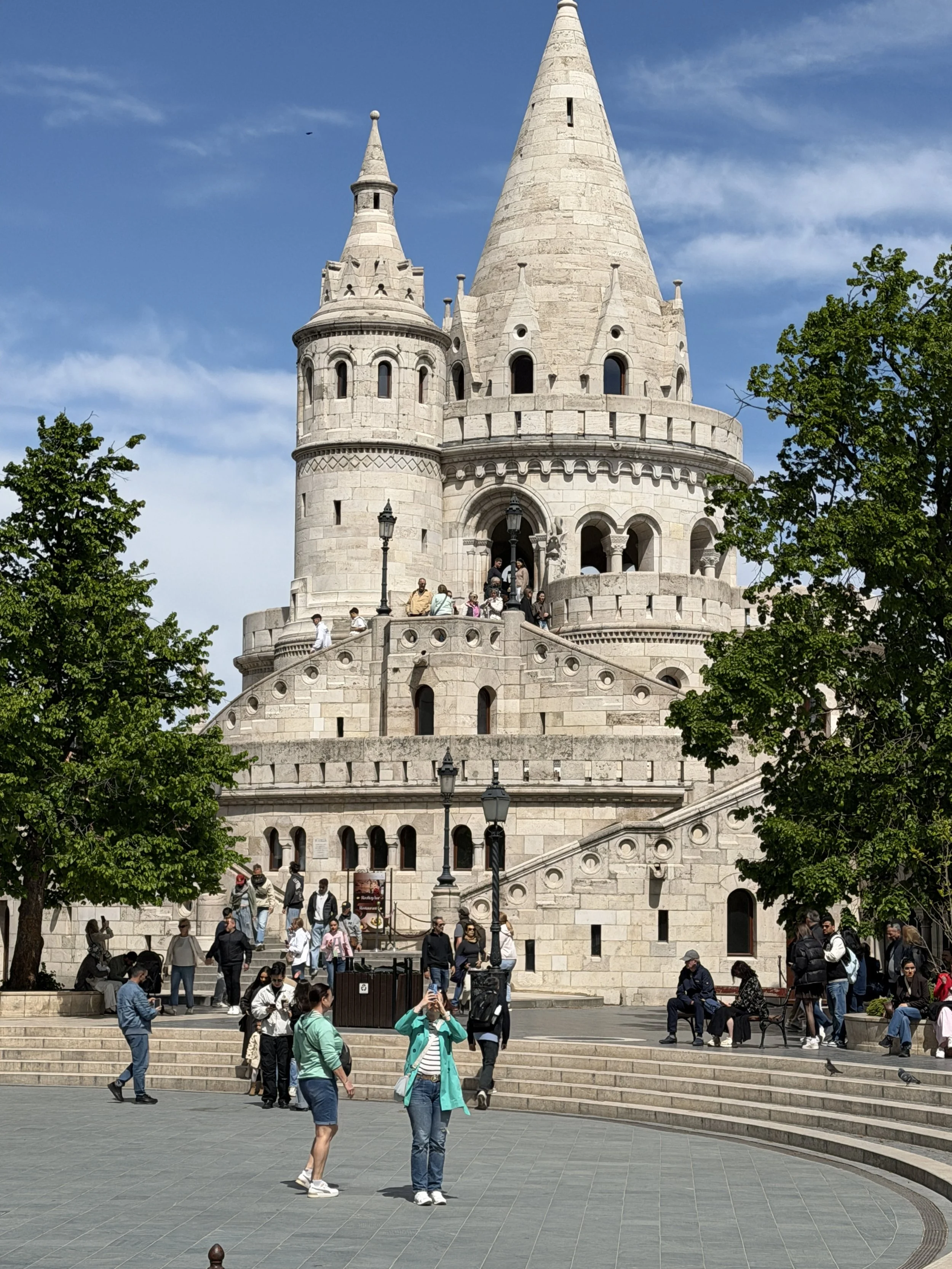
Fisherman's Bastion is a terraced viewing structure on Castle Hill in Buda, built to look like a medieval fortress — but here's the twist locals love to point out: it was never actually a fortification. Despite the turrets, arches, and battlements, it was built purely as a decorative lookout terrace, designed to frame the view and complement the neighboring Matthias Church. If you came expecting a functioning castle wall with a military past, you'll be a little misled by the name — and that's exactly the story worth knowing before you go.
The history of Fisherman's Bastion
Why it's called "Fisherman's" Bastion
Long before the current structure existed, this stretch of Castle Hill was defended by the local fishermen's guild, who lived just below the walls in what was then called Fishtown (Vízváros), and reportedly took responsibility for protecting this section during medieval sieges. When the 19th-century architects went looking for a name, they kept the tribute.

If you want to discover the highlights of Budapest with a licensed toue guide, book your private tour now.
Let's explore Budapest →Who built it, and why
Fisherman's Bastion was designed by Hungarian architect Frigyes Schulek and constructed between 1895 and 1902, as part of the huge wave of building projects marking Hungary's millennial anniversary — 1,000 years since the Magyar tribes settled the Carpathian Basin in 895 AD. Schulek was already restoring the neighboring Matthias Church at the time, and designed the Bastion as a complementary, ceremonial monument meant to frame the church and give Budapest a grand public terrace worthy of the anniversary — not a military structure at all.
The seven towers, explained
This is the detail I love sharing most: the Bastion's seven pointed white towers each represent one of the seven Magyar tribal chieftains who led the original settlement of Hungary in 895 AD. It's a small architectural detail, but once you know it, you'll never look at the skyline the same way.
What happened to it during WWII
The Bastion suffered serious damage during the Second World War and had to be carefully restored — fittingly, the reconstruction was carried out by Frigyes Schulek's own son, János Schulek, continuing the family's connection to the site. During the Communist era, a large red star was hung from the arches facing the Danube, visible from the Pest side as a none-too-subtle political statement — it's long gone now, but it's a detail that surprises most visitors.
The statue in the courtyard
At the center of the southern terrace stands an equestrian statue of King Stephen I (Saint Stephen), Hungary's first Christian king, erected in 1906. The pedestal is decorated with relief carvings depicting key moments of his reign, including his coronation. It's easy to walk past without noticing, but it's one of the most historically significant statues in the city.
Is Fisherman's Bastion free? Tickets and best times to visit
This is the part almost nobody gets right, and it's the single biggest tip I give guests.
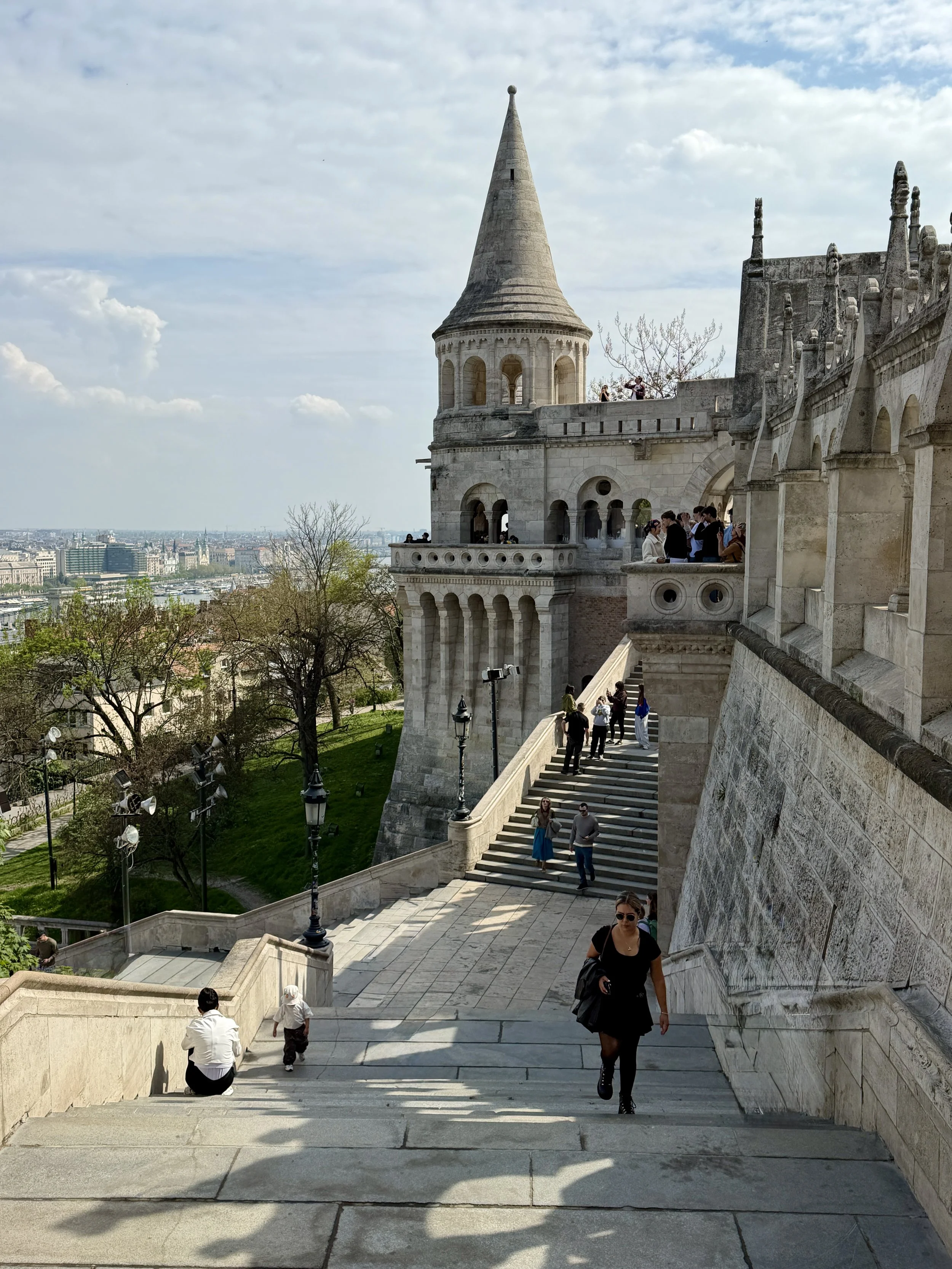
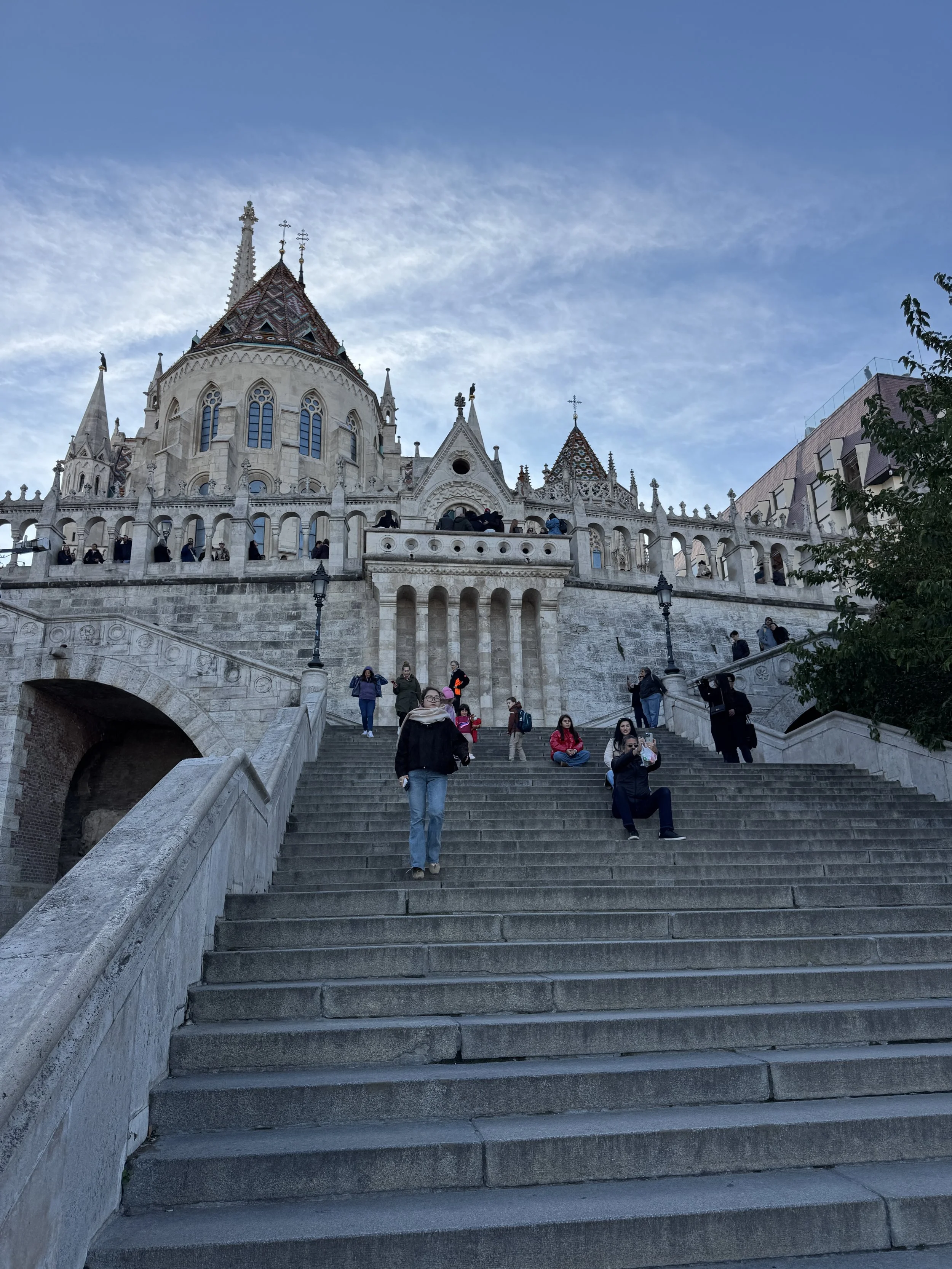
The lower terraces are always free. You can walk the main terrace, take in most of the view, and photograph the towers from below without paying anything, at any time of day.
The upper towers and walkways require a ticket during the day — currently around 1,700 HUF for adults, with 50% discounts for students, EU seniors, and children, as of 2026 pricing. Ticket booths are on-site and take card payment.
Here's the trick: outside of ticketed hours, the entire Bastion — upper towers included — is free to enter. Ticketed hours generally run from around 9 AM until early evening (roughly 7 PM in the colder months, 9 PM in peak summer). Visit early in the morning before opening, or in the evening after the booths close, and you get the same fairy-tale view without paying a forint. It's also free on Hungarian national holidays and during the last week of December.
My honest local take: unless you specifically want to walk inside the towers themselves, the view from the free lower terrace is nearly identical to what you'd see from the paid upper section. Save the ticket money for a coffee at one of the cafés nearby instead.
Best time of day to visit Fisherman's Bastion
Sunrise and just after sunset are, without competition, the best times to be here — both for the light and for the crowds, or lack of them. By mid-morning, tour groups arrive in waves, and by early afternoon it can be genuinely difficult to get an unobstructed photo. If you can only come once, aim for the first hour after opening, or come back after dark when the towers are lit up and the day-trippers have gone.
How to get to Fisherman's Bastion
On foot: from the Buda side of the Chain Bridge, it's roughly a 15–20 minute walk up through the Castle District.
By funicular: the Budavári Sikló funicular runs from near Clark Ádám tér, right at the Buda end of the Chain Bridge, up to Castle Hill in about three minutes — scenic, but expect queues in peak season.
By bus: bus 16 or 16A from Széll Kálmán tér (reachable by metro line M2) drops you close to the Matthias Church end of the Castle District, and it's included in any standard public transport ticket.
What else is nearby
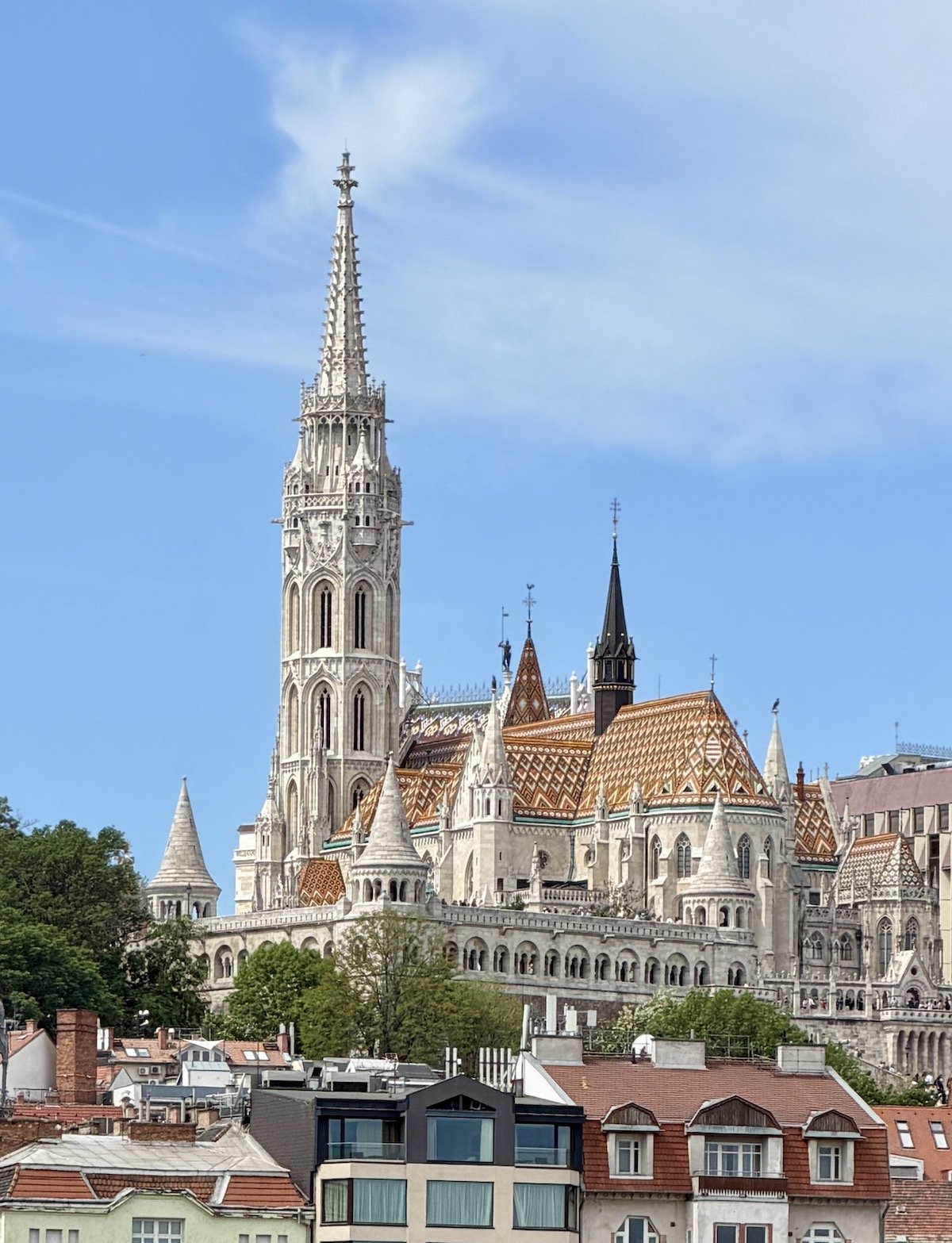
Fisherman's Bastion sits directly beside Matthias Church, also restored by Frigyes Schulek and worth pairing with your visit — the roof tiles alone are a photo opportunity. The wider Castle District, including Buda Castle and the Hungarian National Gallery, is an easy extension if you want to turn this into a half-day outing rather than a quick photo stop.
FAQ
Is Fisherman's Bastion worth visiting? Yes — it's one of the best free (or nearly free) panoramic views in Budapest, and the architecture itself, not just the view, is worth the walk up.
How long should I spend at Fisherman's Bastion? Most visitors spend 30–45 minutes here. Add another 45–60 minutes if you're also visiting Matthias Church next door.
Is Fisherman's Bastion free at night? Yes — outside of daytime ticketed hours (roughly 9 AM to early evening), the entire Bastion, including the upper towers, is free to enter, and it's beautifully lit after dark.
Do I need to book tickets in advance? No — tickets for the upper towers are sold on-site at a small booth, and there's rarely a meaningful queue for the ticket itself, unlike the funicular.
Is Fisherman's Bastion wheelchair accessible? The lower terrace is accessible, but the site includes stairs and uneven historic stonework in several areas, so full mobility access is limited, particularly around the upper towers.
Fisherman's Bastion is one of the first stops on many of my private Budapest walking tours — it's the moment guests usually stop mid-sentence to take a photo. If you'd like a guide to walk you through the Castle District's history in person, get in touch and let's plan your visit.
Enjoyed this one? A few more from the blog you'll probably want to read next:
Budapest food tour: eat way through the city like a local
The Kazinczy street synagogue: Budapest’s hidden orthodox jewel
