The Rubik's Cube Was Invented in Budapest — And Most People Don't Know That
By Kata | katabudapest.com | Updated Oct 10, 2026
There is a puzzle sitting in hundreds of millions of homes around the world. It has been called the best-selling toy of all time. It has inspired world championships, entire subcultures, and debates that have lasted decades. And almost nobody knows it was born right here, in Budapest, in the hands of a quiet Hungarian architecture professor who wasn't even trying to invent a toy.
That professor was Ernő Rubik. And his story is very much a Budapest story.
The Man Behind the Cube
Ernő Rubik was born in Budapest on July 13, 1944. His father was a celebrated glider engineer, his mother a poet — and Rubik absorbed something from both of them. He studied goldsmithing, painting and sculpture before graduating as an architect from the Budapest University of Technology in 1967, then went on to study sculpture and interior design at the Academy of Applied Arts. From 1971 he taught architecture there, becoming fascinated with three-dimensional forms — with the way objects move and relate to each other in space.
In 1974, working in his workshop, he built a prototype from 27 wooden blocks, holding the pieces together with rubber bands, trying to create a structure where individual sections could move independently without the whole thing falling apart. When he finally got it to work, he twisted it a few times — and couldn't get it back to its original state.
It took him a full month to solve his own invention.

From Budapest to the World
Rubik filed his patent in January 1975 and received it in December 1977. Under its original Hungarian name — Bűvös Kocka, the Magic Cube — it appeared in Budapest toy shops in late 1977. The early version was deliberately sturdy: it couldn't easily be taken apart or broken, which made it ideal as a children's toy.
Getting it beyond the Iron Curtain took years. It was only in 1979, through a deal with the American toy company Ideal, that international distribution began. In 1980 the cube made its debut at toy fairs across the Western world, was slightly modified to meet Western packaging and safety standards, and was renamed the Rubik's Cube in honour of its inventor. In the same year it won the UK Toy of the Year award.
What followed was one of the greatest toy crazes in history. Within the first three years of international release, over 100 million cubes had been sold. By 1982, estimates suggested that in some markets every third household had at least one. The term "Rubik's Cube" was eventually added to the Oxford English Dictionary as its own entry.
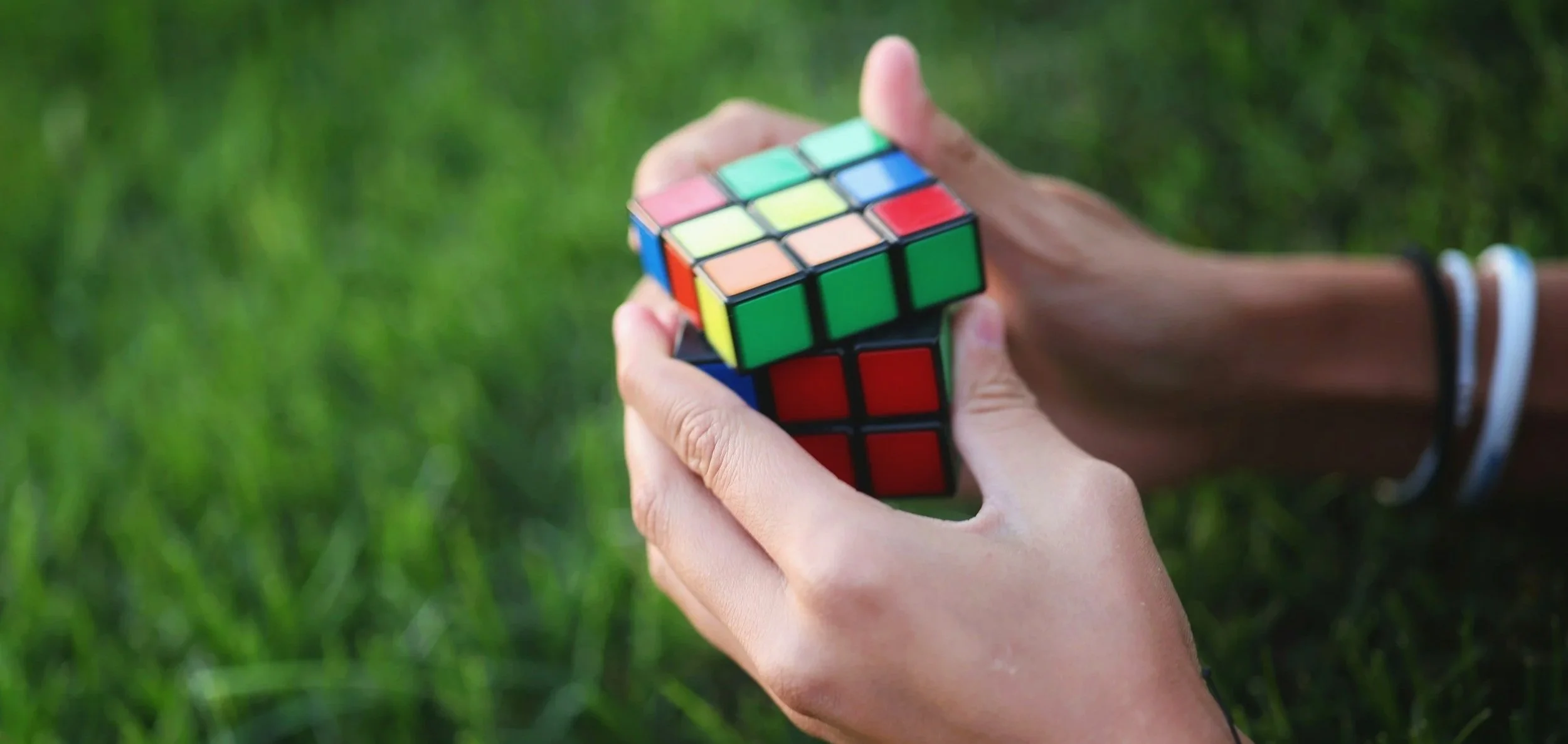
Today, more than 350 million have been sold — making it the best-selling toy ever made
The First World Championship — Held in Budapest
In 1982 the first Rubik's Cube World Championship was held right here in Budapest, at the Vigadó concert hall. Twenty competitors from twenty countries gathered, each selected through national qualifying competitions. They were given 15 seconds to study their scrambled cube before the clock started.
The winner was 16-year-old Minh Thai from the United States, with a time of 22.95 seconds. Second place went to Guus Schultz of the Netherlands with 24.32 seconds, and third to Hungarian competitor Zoltán Lábas with 24.49 seconds. The jury was chaired by Rubik himself.
From 2003, the World Championship has been held every two years, alongside annual national championships in countries around the world. The current world record — set by Max Park at a competition in California in 2023 — stands at 3.13 seconds.
The Numbers That Make Your Head Spin
The cube that Rubik invented has 26 individual smaller cubes and rotates around three axes. This produces more than 43 quintillion possible combinations — that's 43 followed by 18 zeros. Despite this, mathematicians have proven that any scrambled cube can be solved in a maximum of 20 moves. The gap between those two facts is part of what makes it a work of genius.
Rubik himself said it best: "It's not me that matters here, it's the cube. And not even the cube — it's the effect it has had: how it managed to hold the attention of so many people for so long, remaining popular across generations as the world changed enormously around it."
A Few Things You Might Not Know
The cube's addictive quality was so powerful that doctors began recording new medical complaints — "Rubik's wrist" and "Rubik's thumb" — among the most devoted players. In 1992, British Prime Minister John Major used a Rubik's Cube at the Edinburgh European leaders' conference to illustrate the near-impossible complexity of the Maastricht Treaty. And in Connecticut, a football player named Bob Blake failed to show up for a match — he was found in the changing room, still trying to solve his cube.
Find It in the City
Budapest hasn't forgotten its most famous puzzle. If you know where to look, the city pays quiet tribute to it in a couple of lovely ways.
On Rumbach Sebestyén utca in the 7th District — right in the heart of the Jewish Quarter, a few steps from Szimpla Kert — there is a large Rubik's Cube mural painted on the side of a building. It's vivid, impossible to miss once you're on the street, and makes for a great photo. I walk past it regularly on tours and it never fails to spark a conversation.
Then there is the Kolodko mini statue. Mihály Kolodko is the Hungarian-Ukrainian sculptor behind the beloved series of tiny bronze figurines hidden around Budapest — the mini Gulliver by the Chain Bridge, the mini fisherman on the Danube bank, and dozens of others tucked into unexpected corners of the city. One of them is a tiny Rubik's Cube, hidden somewhere in the city for those willing to hunt for it. Finding a Kolodko statue always feels like a small reward — a secret shared between the city and the people who pay attention to it. And if you've caught the Kolodko bug, don't forget to check out my blog post all about the mini statues — there are more than you think.
Why It Matters
When I take guests around the city, I love this story for one simple reason: it perfectly captures something Budapest does again and again. It takes a person of unusual intelligence and curiosity, gives them a city full of culture and complexity, and watches what emerges.
Rubik wasn't trying to disrupt an industry. He was a professor interested in spatial geometry, working in a university workshop, playing with wooden blocks. The result changed popular culture for fifty years and counting.
If you want to take a piece of Budapest home with you, a Rubik's Cube is genuinely one of the most meaningful souvenirs you can buy. It carries the fingerprints of this city's particular kind of brilliance.
And if you'd like to hear more stories like this one — about the inventors, thinkers, composers and artists that Budapest quietly gave to the world — come on a tour with me.
Enjoyed this one? A few more from the blog you'll probably want to read next:
Where Budapest Really Shops: Inside the Klauzál Square Market Hall
Szimpla Kert: Is It Still Worth Seeing in Budapest?
Why You Should Visit the Citadella for Sunset in Budapest
Kaptafa Brunch: The Jewish Quarter Spot That Makes Breakfast Fun Again
