Why Is Heroes' Square Missing Its Angel Statue?
By Kata | katabudapest.com | Published July 18, 2026
If you've stood in Heroes' Square recently and looked up at the tall column in the middle of the Millennium Monument expecting to see a bronze angel with outstretched wings, you may have noticed something: he's not there. Visitors ask me about this all the time on my tours, usually with a confused look on their face and a phone pointed at an empty column top. So let me explain who that angel is, why he's missing right now, and why he's actually one of the most important figures in the whole story of Hungary.
Who Is the Angel on Top of Heroes' Square?
The figure at the very top of the 36-meter Corinthian column at the center of Heroes' Square is the Archangel Gabriel. He was created by the sculptor György Zala and has stood watch over Budapest since October 1901, when the Millennium Monument was unveiled to mark 1,000 years since the Hungarian conquest of the Carpathian Basin.
Gabriel isn't just decoration. In his right hand he holds the Hungarian Holy Crown, and in his left, the apostolic double cross. Both objects connect directly to the founding legend of Christian Hungary, which is why I always tell my guests: this isn't just a pretty statue, it's practically the national origin story cast in bronze.
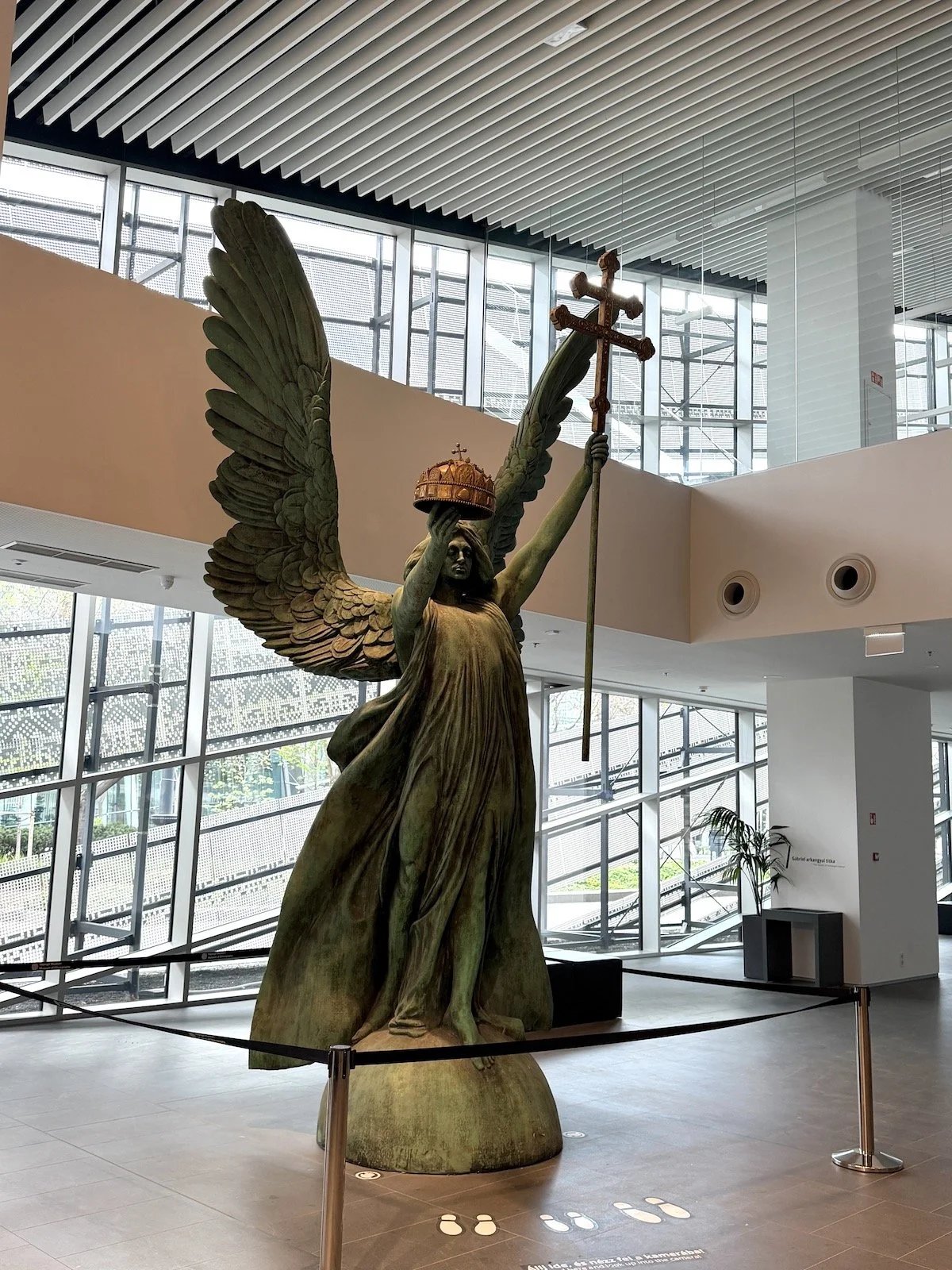
Gabriel holds the Hungarian Holy Crown and the apostolic double cross
The Legend Behind the Statue
According to Hungarian tradition, Pope Sylvester II originally intended to send the Holy Crown to the ruler of Poland. The night before it was to be sent, the pope had a dream in which the Archangel Gabriel appeared and told him to give the crown instead to the envoy who would arrive from an unknown land the very next morning. That envoy turned out to represent István (Stephen), the Hungarian prince who would become Hungary's first Christian king in the year 1000.
That's why Gabriel stands at the center of Heroes' Square holding exactly those two objects: the crown he told the pope to send, and the cross symbolizing Hungary's new status as a Christian kingdom, personally sanctioned, according to legend, by an archangel. For a monument built to celebrate a thousand years of Hungarian history, there was really no better figure to put at the top.

So Where Did He Go?
In September 2024, Gabriel came down off his column for the first time in over 120 years. After more than a century of Budapest weather, the almost five-meter bronze statue had deteriorated significantly, and rainwater had gotten into its interior over the decades. Earlier repairs, like the one done in the mid-1990s ahead of the millecentenary celebrations, had only ever addressed the surface. This time, restorers wanted to fix the structure itself, along with the stone column and Corinthian capital that support it.
The statue was carefully dismantled in pieces (the Holy Crown and double cross were even removed separately by hand) and taken to a conservation workshop for the most thorough restoration in its history.
As of mid-2026, Gabriel is still off-site while the assessment and restoration work continue. Officials have said the goal is to have him back on his column by the end of 2026, once it's confirmed the supporting column doesn't need extensive additional structural work. So if you're visiting Budapest this year, there's a real chance you'll catch Heroes' Square without its angel, but there's also a good chance you'll catch history in the making, watching him go back up.
You Can Still See Him, Just Not on the Column
The nice surprise for visitors is that you don't have to just imagine what Gabriel looks like. A life-size replica has been on display at the City Park Visitor Center, inside the Museum of Ethnography building right next to Heroes' Square, as part of a free exhibition on the statue's history and restoration. It's actually a rare chance to see Gabriel up close, at eye level, rather than squinting up at him from 36 meters below like everyone has for the last 120-plus years. I usually point my guests toward this exhibit while the statue is away, since it adds real context you simply can't get standing in the square alone.
Why This Statue Matters So Much to Hungarians
Heroes' Square and its Millennium Monument were never meant to be just a pretty backdrop for photos. The monument was conceived in 1891 to mark a thousand years of Hungarian statehood, and it lays out the entire arc of the nation: the seven Magyar chieftains who led the conquest at the base, Hungary's kings and statesmen along the colonnades, and Gabriel presiding over all of it from the top, representing the moment Hungary became a Christian kingdom recognized by Europe.
The square has lived through Hungary's turbulent twentieth century right alongside the rest of the country. During the short-lived Hungarian Soviet Republic in 1919, statues of Habsburg rulers were torn down elsewhere on the monument, and the column with Gabriel on it was covered with a red veil, with a bust of Karl Marx placed in front of it for a time. The Tomb of the Unknown Soldier was later added at the foot of the monument, following a trend seen across Europe after the World Wars. Through occupation, war, and political upheaval, this square has repeatedly been the place where Hungary chose to stage its most important national moments, for better and for worse.
So when people ask why locals seem to care so much about one bronze statue being temporarily missing, that's why. Gabriel isn't just an angel on a column. He's a symbol of the moment Hungary chose its place in Christian Europe, and he's been watching over the country's highs and lows for well over a century.
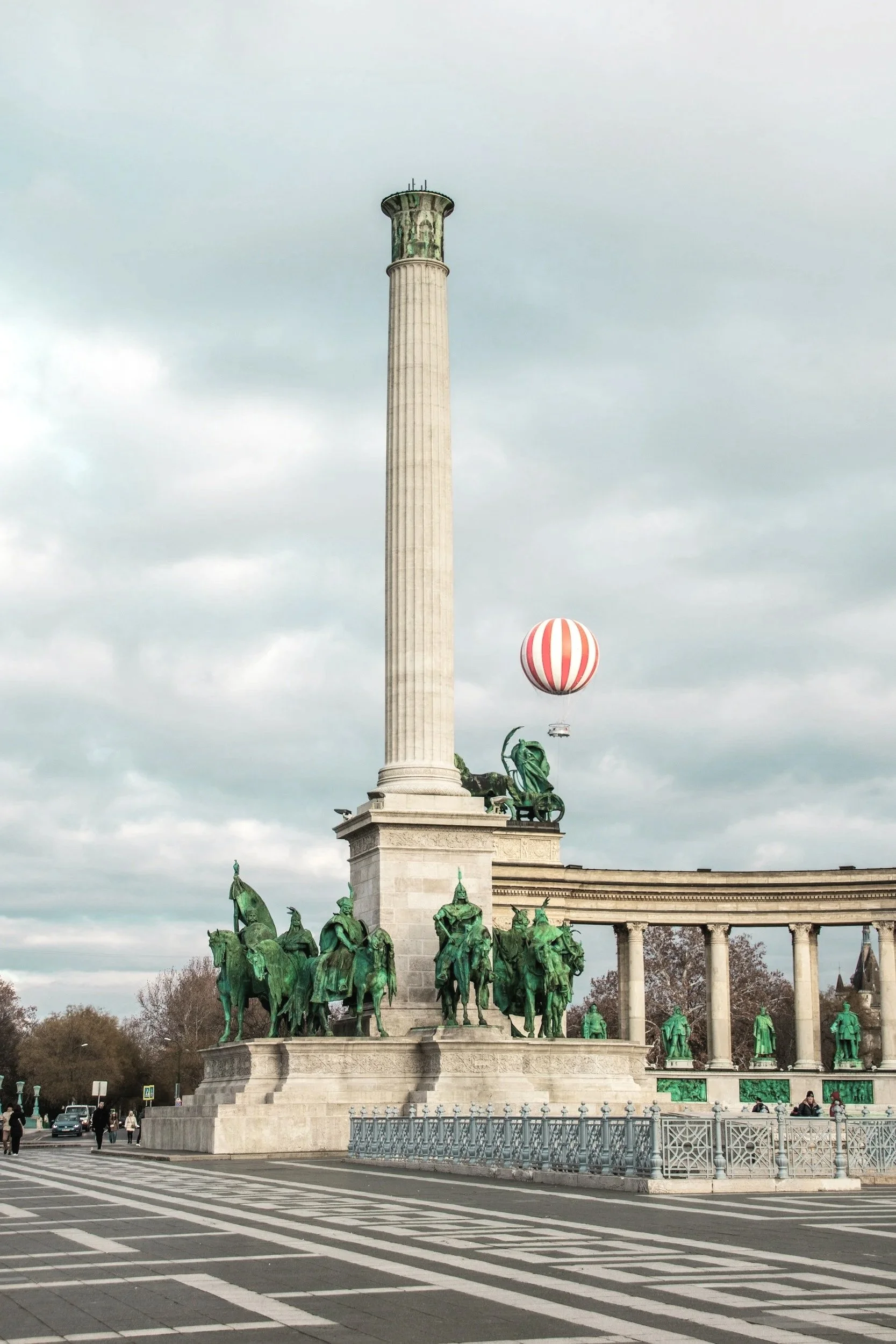
Bare Corinthian column where the Archangel Gabriel statue normally stands, Heroes' Square Budapest
Visiting Heroes' Square While Gabriel Is Away
A few tips if you're planning a visit this year:
The rest of the Millennium Monument, including the colonnades with statues of Hungary's kings and the seven Magyar chieftains at the base, is fully visible and worth the visit on its own.
Stop by the free exhibition at the City Park Visitor Center in the Museum of Ethnography building to see the replica statue up close and learn about the restoration.
Heroes' Square sits right at the edge of City Park (Városliget), so it pairs naturally with a visit to Vajdahunyad Castle, the Széchenyi Thermal Bath, or the Budapest Zoo.
If you want the full story, from the legend of the Holy Crown to the political upheavals the square has witnessed, it's the kind of history that's much more interesting with someone to walk you through it in person than with a guidebook.
Frequently Asked Questions
Why is the statue on top of Heroes' Square missing? The Archangel Gabriel statue was removed in September 2024 for its first full restoration in over 120 years, after experts found significant deterioration to the bronze figure and the column supporting it.
When will the Archangel Gabriel statue return to Heroes' Square? Officials have said the statue may return by the end of 2026, depending on how much structural work the supporting column still needs.
What does the Archangel Gabriel statue represent? Gabriel holds the Hungarian Holy Crown and the apostolic double cross, referencing the legend in which the archangel told Pope Sylvester II to send the crown to the Hungarian envoy rather than to Poland, leading to the coronation of Hungary's first king, István (Stephen), around the year 1000.
Can I still see the statue while it's being restored? Yes. A life-size replica is on display as part of a free exhibition at the City Park Visitor Center in the Museum of Ethnography building, right next to Heroes' Square.
Who created the Archangel Gabriel statue? It was designed by Hungarian sculptor György Zala and unveiled on October 24, 1901, as part of the Millennium Monument.
Curious about the stories behind Budapest's landmarks? I'd love to walk you through Heroes' Square, City Park, and the rest of the city's history in person. Get in touch to plan your private Budapest tour, and I'll make sure you leave knowing a lot more than just where the missing angel went.
Enjoyed this one? A few more from the blog you'll probably want to read next:
Where Budapest Really Shops: Inside the Klauzál Square Market Hall
Szimpla Kert: Is It Still Worth Seeing in Budapest?
Why You Should Visit the Citadella for Sunset in Budapest
Kaptafa Brunch: The Jewish Quarter Spot That Makes Breakfast Fun Again
